That stump sitting in your yard after a tree comes down isn't just an eyesore; it's a growing problem. Here's what to do about it.
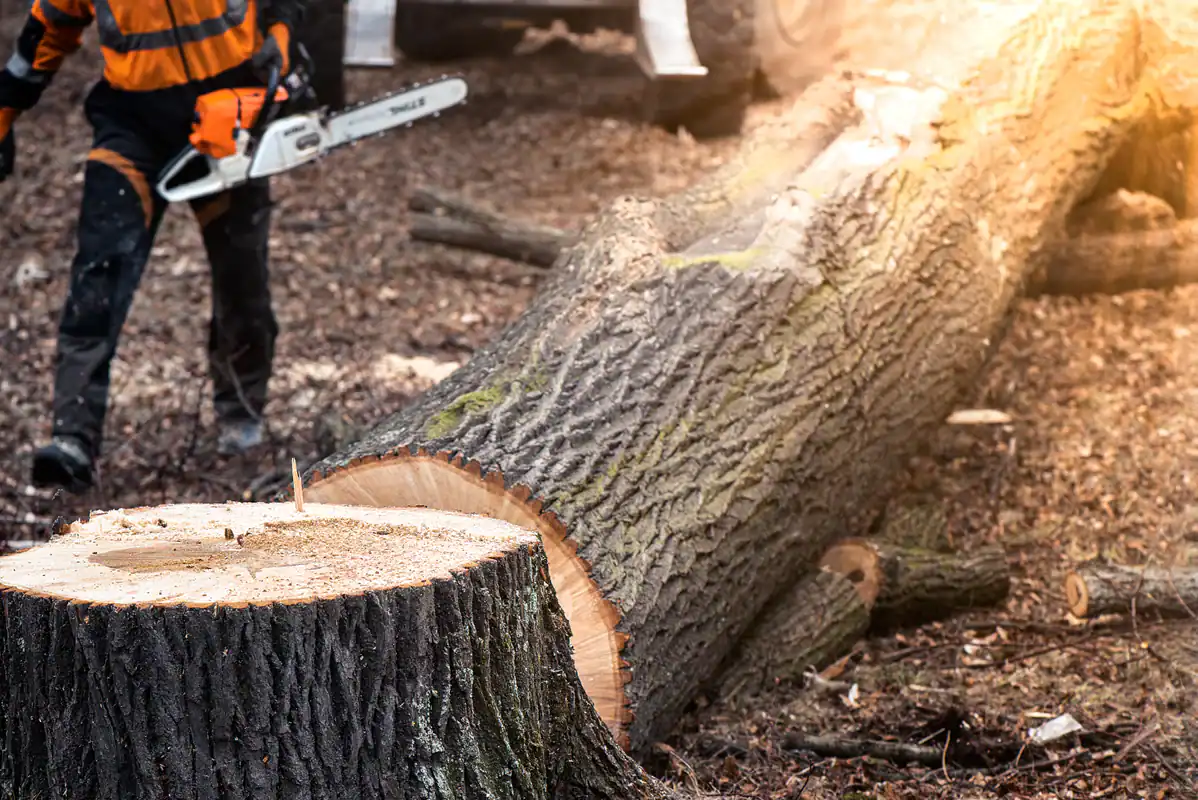
The tree is gone. The crew packed up, cleaned the big stuff, and drove off. And now you’re standing in your yard staring at a stump that nobody mentioned. It’s not an emergency (not yet), but it’s not nothing, either. It’s in the way when you mow. It’s an eyesore when you’re trying to enjoy the yard. And depending on where you live in the Kansas City metro, your HOA may already have something to say about it.
This guide is for anyone who’s reached that moment and is trying to figure out what comes next, and if it’s worth dealing with now or later. Spoiler: it’s worth dealing with now.
Stump grinding is exactly what it sounds like: a machine with a rotating metal disc fitted with hardened steel teeth grinds the stump down into wood chips. The goal isn’t just to make it flush with the ground. A proper job takes the stump below grade, typically four to six inches beneath the soil line, so the area is level, safe, and usable again.
The wood chips produced during the process can be left in place and used as natural mulch, or hauled away depending on your preference. What stump grinding does not do is remove the root system; the roots stay in the ground and decompose naturally over time. For most residential situations in Kansas City, that’s completely fine. If you’re planning to build over the area or replant in the exact same spot, a deeper grind or full excavation may be worth discussing.
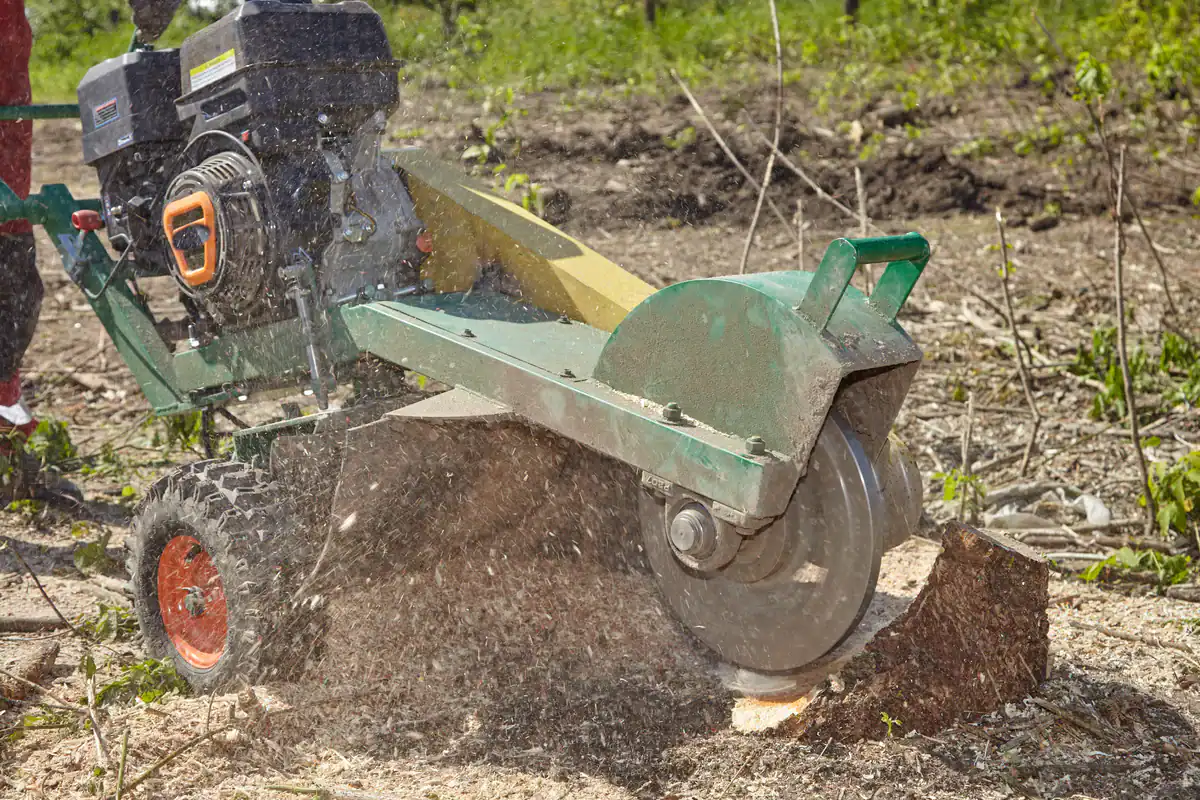
This is one of the most common points of confusion, and it’s worth clearing up before you call anyone. Stump grinding reduces the visible stump to below-ground wood chips while leaving the root ball in place. Full stump removal, by contrast, means excavating the entire stump and root system out of the ground, which is a significantly more labor-intensive job that leaves a much larger hole to fill in afterward.
For the vast majority of Kansas City homeowners, stump grinding is the right call. It’s faster, less disruptive to the surrounding lawn, and more cost-effective. Full removal tends to make sense when you’re doing major construction directly over the root zone, or when a specific species is known to produce aggressive surface roots that will keep causing problems if left underground.
The other thing worth knowing is that stump grinding and tree removal are two separate services, and not every tree company does both in-house. Some subcontract the grinding out, which can add time and cost to your project. When you book both together with us, you’re typically looking at better scheduling, cleaner coordination, and less back-and-forth.
One more thing homeowners often ask: will the stump grow back after grinding? The stump itself won’t. However, if the tree was a species that produces root suckers (cottonwoods are a common example here in Kansas City), you may see some sprouts emerge from the remaining root system. That’s manageable and far less of an issue than leaving the full stump in place for years.
A lot of homeowners decide to deal with the stump later. It’s understandable; you’ve already spent money on the tree removal, and the stump isn’t actively causing problems. Not yet, anyway. Here’s what tends to happen over time. Rotting wood is one of the most reliable attractants for termites, carpenter ants, and wood-boring beetles. Once those insects establish themselves in a decaying stump, they don’t always stay there. A stump near your foundation or close to your home’s structure becomes a bridge. The same goes for fungal disease: certain fungi that take hold in a dead stump can spread through the root system to healthy trees nearby.
Kansas City already has enough to worry about with oak wilt moving through the metro and the damage the emerald ash borer has done across Johnson County. A decaying stump doesn’t need to add to that.
There’s also the practical side. Mowing around a stump is a nuisance at best and a blade hazard at worst. If the stump is in a high-traffic area of your yard, it’s a genuine tripping hazard, especially for kids and older adults. And if you live in one of the HOA-governed communities in Overland Park, Leawood, Lenexa, or Olathe, a visible stump can put you in violation of community rules faster than you might expect.
Natural decomposition sounds like a free solution, but hardwood stumps (and Kansas City yards are full of oaks, maples, cottonwoods, and elms) can take anywhere from three to seven or more years to break down on their own. That’s years of the problems above compounding in your yard before the stump disappears on its own.
Want live answers?
Connect with a Squirrel Master Tree Services LLC expert for fast, friendly support.
Most people have the same handful of questions before they pick up the phone, and they’re all reasonable ones. What’s it going to cost? Can I just rent a machine and do it myself? Do I need a permit? What happens after the job is done?
The answers aren’t complicated, but they’re worth knowing before you commit to anything. We’ve answered the ones we hear most often below, providing the kind of straight answers you’d want from someone who does this work in Kansas City every day.
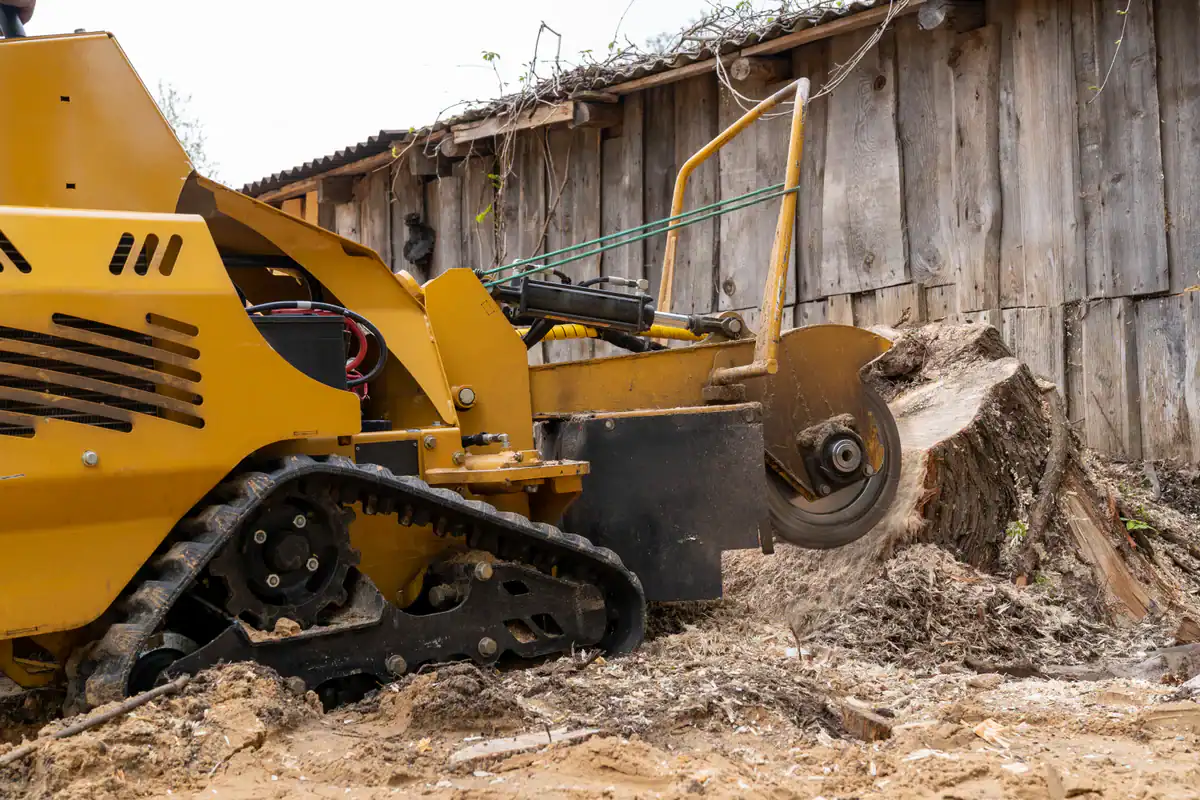
The DIY route is tempting, especially when you can rent a stump grinder by the day. Rental costs for a residential-grade machine typically run between $100 and $400 per day, and on the surface, that seems cheaper than hiring someone. But it rarely works out that way once you factor in everything involved.
First, there’s the equipment itself. Rental grinders are smaller and less powerful than professional machines. For a softwood stump (such as pine or cedar), that might be fine. But Kansas City yards are dominated by hardwoods: oaks, maples, cottonwoods, elms. These species are dense and can add significant time and effort to the job.
What looks like an afternoon project can turn into a full day of grinding, stopping to clear debris, grinding again, and still not getting the stump as deep as you’d want.
Second, and more importantly, there’s the underground utility question. Before any stump grinding begins, 811, the national “Call Before You Dig” service, needs to be contacted to locate underground lines. Gas lines, water lines, electrical conduit: they run through residential yards across the Kansas City metro, and a stump grinder hitting one of them is not a small problem. We handle this as a standard part of the job. If you’re renting a machine yourself, that responsibility falls entirely on you.
Then there’s the safety equipment: eye protection, hearing protection, heavy boots, and the knowledge to operate the machine without sending debris into your siding, windows, or a neighbor’s yard. Professional stump grinders are built to throw wood chips, and they do so forcefully.
When you add it all up (rental cost, fuel, transport, the time it takes, and the liability if something goes wrong), hiring a professional is often the more practical choice, not just the easier one. We offer free, same-day quotes throughout the Kansas City metro, so you can get a real number before you decide anything.
This is a question that catches a lot of homeowners off guard. The short answer is: it depends on the situation, and it’s worth asking before any work begins.
In Kansas City, permits are generally required for removing certain protected tree species or trees above a specific size threshold. If the tree was already removed under a permit, the stump grinding that follows is typically covered. If you’re dealing with a stump from a tree that came down in a storm, or one that was removed years ago without a permit, the situation may be different.
What this means practically is that working with a licensed local company matters. We know the Kansas City permitting landscape, and we can tell you upfront if your job requires any additional steps before we start. That’s the kind of thing that doesn’t come up in a rental transaction; you’re on your own to figure it out.
The same logic applies to insurance. Missouri requires an occupational license for tree services, and any reputable company operating in the Kansas City metro should be able to confirm they’re both licensed and insured. We are, and we’ll tell you so directly. If a company you’re talking to can’t confirm that clearly, that’s a reason to keep looking.
One more practical note: if you’re planning to replant or lay sod over the ground area after grinding, let the crew know ahead of time. Standard grinding depth is four to six inches below grade, which is sufficient for most uses. If you need deeper work to support new planting or construction, that’s worth discussing before the job starts rather than after.
Stump grinding isn’t complicated, but it’s one of those things that gets easier (and cheaper) the sooner you deal with it. Waiting doesn’t make the stump smaller. It makes the pest problem bigger, the HOA notice more likely, and the project slightly more involved each season you let it go.
If you’ve got a stump left over from a tree removal, a storm, or just years of procrastination, we can help. Squirrel Master Tree Services has been handling stump grinding and tree care across the Kansas City metro (on both sides of the state line) for over a decade.
We give straight answers, fair prices, and free same-day quotes on most jobs. No runaround, no surprise charges, and we clean up before we leave.
Reach out to us whenever you’re ready. We’ll come take a look, give you a real number, and let you decide from there.
Summary:
Article details:
Share: