Some trees look fine until they don't. Here's how to spot the real warning signs before a dead or damaged tree becomes a serious problem.
Most people don’t think much about the trees in their yard — until a branch comes down in a storm, a root starts lifting the driveway, or a neighbor mentions something looks off. By then, the situation is usually more urgent than it needed to be. Tree problems rarely fix themselves. They tend to get quieter for a while, then suddenly much worse. If you’ve got a tree you’ve been keeping an eye on — one that looks a little off, leans a little more than it used to, or drops dead branches after every storm — this page is for you.
Trees don’t announce when they’re in trouble. The signs are usually subtle at first — a patch of bark that looks wrong, a section of canopy that didn’t leaf out in spring, a slight lean that wasn’t there last year. The challenge is knowing which signs mean “keep an eye on it” and which ones mean “call someone this week.”
A few things can help you make that distinction. Dead branches concentrated in the upper canopy are one of the clearest early signals — healthy trees don’t drop significant limbs without cause. Bark that’s cracking, peeling in large sheets, or falling away from the trunk in chunks is another. If you scratch a small section of bark with your fingernail and the wood underneath is dry and brown rather than green or white, that section of the tree is dead.
The most dangerous trees aren’t always the ones that look the worst. A tree can appear full and healthy on the outside while rotting from the inside out — and that’s exactly what makes certain hazards so easy to miss until it’s too late.
One of the clearest external indicators of internal decay is fungal growth. If you see mushrooms growing from the base of the trunk, from exposed roots, or directly out of the bark, that’s not a coincidence — it’s a sign of active rot inside the wood. The fungus is breaking down the structural fibers that hold the tree upright. By the time mushrooms are visible, the decay is often already significant.
Cracks in the trunk are another serious signal, especially vertical splits or cracks that run through a major branch attachment point. A V-shaped crotch — where two large limbs fork off at a narrow angle — is a known structural weak point. When you see a crack forming right at that junction, the branch above it can fail without much warning, even on a calm day.
Lean is worth paying close attention to as well, but context matters. A tree that has always had a slight natural lean is different from one that has started leaning progressively, or one that shifted noticeably after a wet season or a storm. A lean of more than 15 degrees from vertical is generally considered a removal indicator, particularly when it’s pointed toward your house, a fence, or a neighboring structure. If the soil on the opposite side of the lean is heaving or cracking, that’s a sign the root system is losing its grip — and that tree is not going to correct itself.
Dead branches in the upper canopy deserve special attention. A single dead limb can weigh hundreds of pounds. When it falls — and eventually it will — it falls fast and without warning. In Kansas City neighborhoods with mature tree canopy, like Brookside, Waldo, or Hyde Park, these “widow makers” are a real and recurring hazard, especially heading into spring storm season.
The root system is the foundation of any tree, and it’s also the part you can’t see — which is why root problems tend to go unnoticed until they’ve already become serious. Kansas City’s heavy clay soils make this worse. Clay expands when wet and contracts when dry, and those cycles put consistent stress on root systems over time, particularly for older trees that have been through decades of Kansas City summers and winters.
What you can look for at ground level: soil that’s visibly heaving or cracking near the base of the tree, especially on the side opposite a lean. This kind of ground movement often means the root plate — the wide, shallow network of roots that anchors the tree — is starting to lift. Once that process begins, it doesn’t reverse. The tree is losing its anchor.
Mushrooms or shelf-like fungal growths at the base of the trunk or along surface roots are a direct indicator of root rot. Construction activity near a tree can also cause root damage that isn’t immediately obvious — compacted soil, cut roots from excavation, or changes in drainage can all compromise a root system that looked fine a few years ago.
If 50 percent or more of a tree’s root system has been damaged — whether from rot, construction, erosion, or soil compaction — removal is generally the recommended course of action. A tree with a compromised root system may stand for another year or two, but it’s unpredictable, and unpredictable trees near homes, driveways, or fences are a liability problem, not just a landscaping one.
One thing many Kansas City homeowners don’t realize: if you knew — or reasonably should have known — that a tree on your property was hazardous, and it falls and damages a neighbor’s property or injures someone, you can be held legally responsible. Your homeowner’s insurance typically won’t cover that scenario either, since policies generally only cover tree damage caused by a sudden covered event like a windstorm — not damage from a tree that was already in decline. That changes the math on “wait and see” pretty quickly.
Want live answers?
Connect with a Squirrel Master Tree Services LLC expert for fast, friendly support.
Tree removal decisions don’t happen in a vacuum. In Kansas City, MO, a handful of local factors push certain situations from “monitor it” to “handle it now” — and understanding those factors can help you make a better call about what’s actually at stake in your yard.
The most significant one right now is the Emerald Ash Borer. The Kansas City metro has an estimated 4.6 million ash trees across the nine-county region, with more than 400,000 of those on private property in Kansas City, MO alone. EAB has been active here for over a decade, and the entire state of Missouri is under quarantine. If you have an ash tree that’s losing bark, showing S-shaped galleries under the surface, or declining from the top of the canopy downward, it may have already crossed the line from treatable to remove-it-now.
This is one of the most common questions we hear from homeowners in the Kansas City area right now, and the honest answer is: it depends on how far the infestation has progressed, but the window for effective treatment closes faster than most people expect.
Ash trees with less than 30 to 50 percent canopy dieback can sometimes be treated successfully with systemic insecticides, but once a tree has lost more than half its canopy to EAB, treatment is generally no longer a viable option. At that point, the tree’s vascular system is too compromised to move the treatment through the wood effectively, and the structural integrity of the trunk and major branches is already declining.
What makes EAB-killed ash trees particularly dangerous — more so than many other dead trees — is how the wood behaves after death. Ash becomes brittle quickly, and the wood tends to shatter rather than break cleanly. That matters a lot during removal. A tree that’s been dead for two or three years is significantly harder and more dangerous to take down than one that was removed while the decline was still early. If you’re waiting to see how bad it gets before making a decision, you’re also increasing the cost and complexity of the eventual removal.
Signs that your ash tree may already be past the treatment threshold: significant dieback in the upper canopy, bark that’s sloughing off in large sections, visible woodpecker activity (they go after EAB larvae), and S-shaped tunnels visible under loose bark. If your ash tree is near your home, garage, or a fence line, getting a professional assessment sooner rather than later is worth the call.
Kansas City’s spring and summer storm season is serious. The metro sits squarely in tornado alley, and even storms that don’t produce tornadoes can bring straight-line winds strong enough to snap large limbs, uproot shallow-rooted trees, or push an already-leaning tree past the point of no return. If a storm has come through your neighborhood and something about a tree looks different afterward — a new lean, a major crack that wasn’t there before, a large limb hanging by a thread — that’s not a situation to wait out.
A partially uprooted tree is not a stable tree. Even if it’s still standing, the root plate has already shifted, and the next rain or wind event can finish the job. A large limb that’s cracked but still attached — what we call a “widow maker” — can fall at any time, including on a calm, clear day, because the structural failure already happened during the storm.
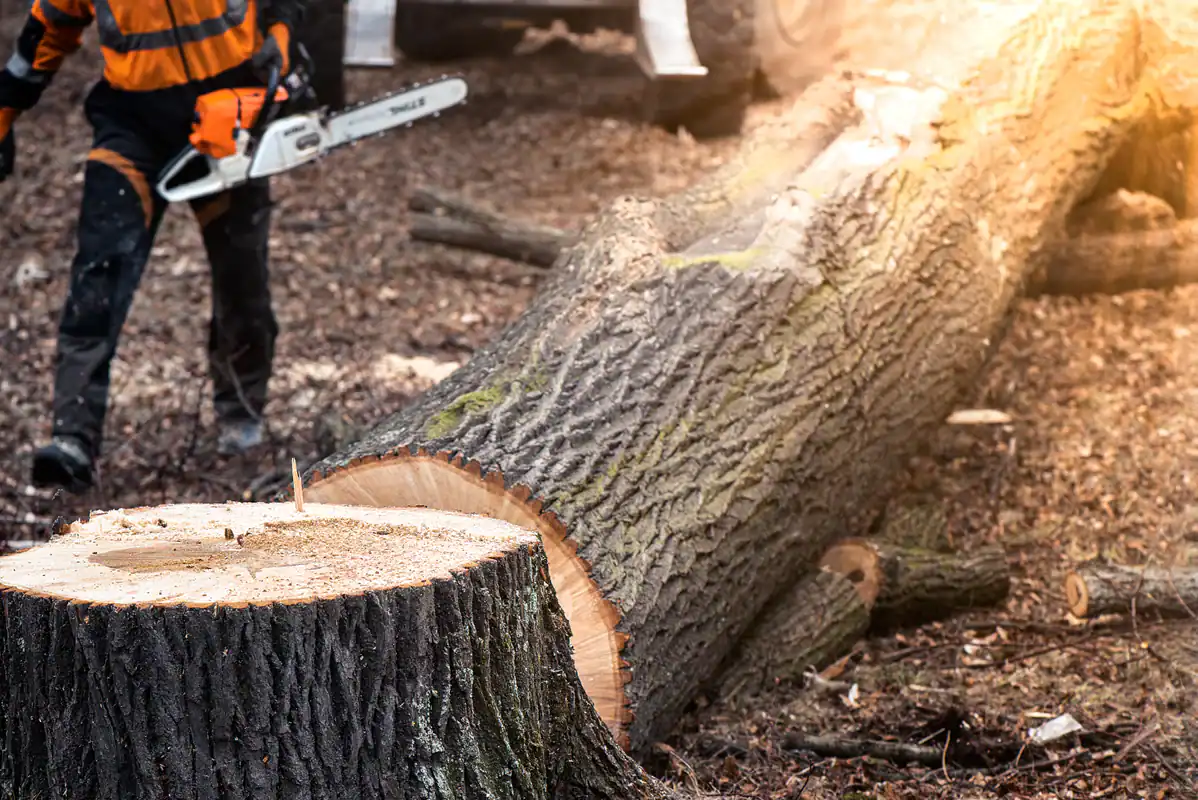
Fallen tree removal is its own category. If a tree or large limb has already come down on your property, the priority is assessing what it’s touching. A tree on a roof, a fence, or a vehicle needs to be handled carefully — not just cut up and hauled away. The weight distribution matters, and removing it in the wrong sequence can cause additional damage to whatever it’s resting on.
One thing worth knowing about insurance: if a tree falls on your home during a covered storm event, your homeowner’s policy will typically cover damage to the structure and may contribute to removal costs. But if the tree was already dead or visibly declining before the storm, your insurer can — and often does — argue that the damage was preventable. That’s a denial you don’t want to be dealing with while also managing storm cleanup. Getting ahead of dead or hazardous trees before storm season is genuinely the smarter financial move, not just the safer one.
If you’ve been watching a tree in your yard and something feels off, trust that instinct. The warning signs covered here — internal rot, root heaving, canopy dieback, new lean, fungal growth, EAB damage — don’t improve on their own. They develop slowly, then suddenly.
Getting a professional assessment doesn’t commit you to anything. It just gives you accurate information about what you’re actually dealing with, so you can make a real decision instead of a delayed one. In most cases, a tree that needs to come down is cheaper and safer to remove before a storm forces the issue.
We at Squirrel Master Tree Services have safely removed more than 1,200 trees across Kansas City neighborhoods — with a 100% safety record. We offer free estimates, straightforward pricing with no hidden fees, and we serve both the Missouri and Kansas sides of the metro. If you’ve got a tree you’re not sure about, we’re happy to take a look.
Summary:
Article details:
Share: