Everything Kansas City homeowners want to know about stump grinding, including cost, process, timing, and what happens after the grinder leaves.
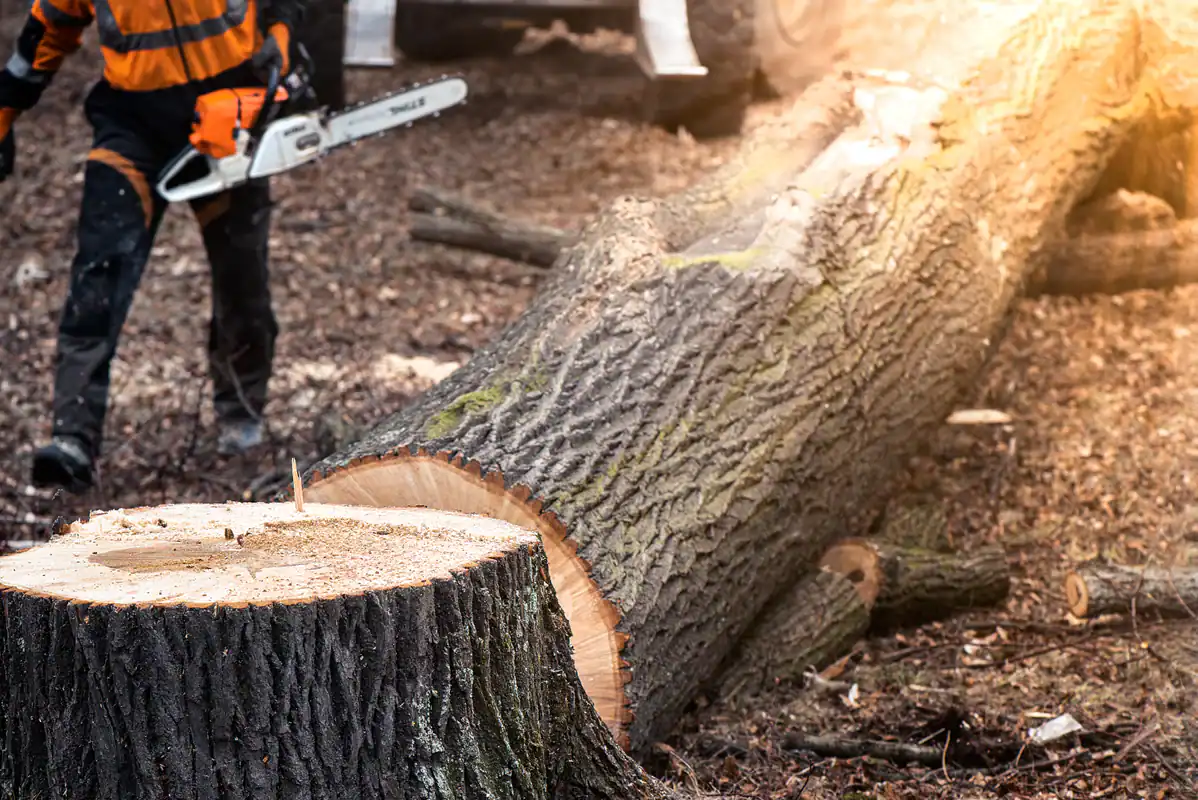
You had a tree removed. The crew packed up, cleaned up, and left. Now there’s a stump sitting in your yard that nobody mentioned was staying behind. Or maybe it’s been there for years and you’re finally done working around it every time you mow. Either way, you’ve got questions, and most of what you’ll find online is either too vague or written for someone in a completely different part of the country.
Kansas City has its own soil, its own tree species, and its own storm history. The answers here reflect that. Let’s get into it.
Stump grinding is precisely what it sounds like. A machine with a rotating cutting wheel grinds the stump down below ground level, turning it into wood chips. It doesn’t pull the entire root system out of the ground. The lateral roots stay underground and break down naturally over time. What’s gone is the visible stump and enough of the base that you can fill the area, reseed it, or grade over it.
The depth matters. A professional grind typically goes anywhere from four to twelve inches below grade. If you’re just trying to get the stump out of sight, four to six inches is usually enough. If you want to plant grass, lay sod, or eventually put a patio or structure over that spot, you’ll want to go deeper. That’s a conversation worth having before the work starts, not after.
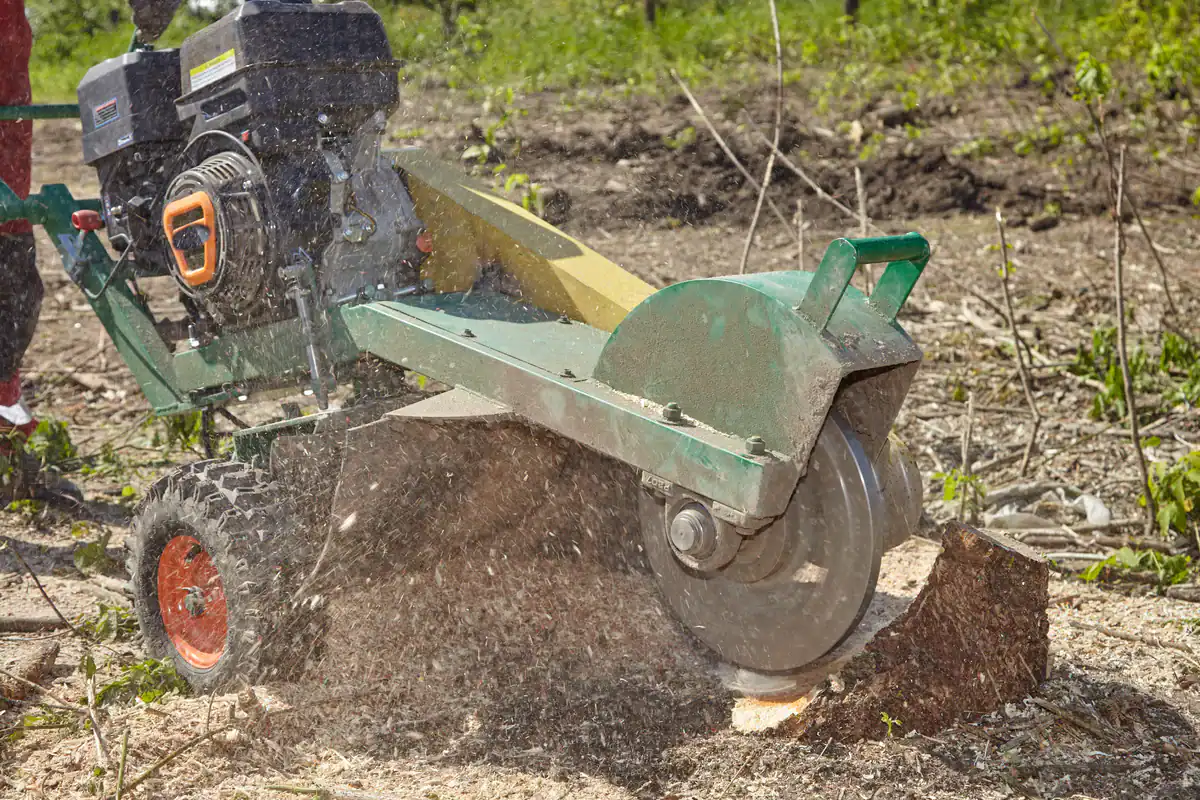
This is one of the most common things people don’t think to ask until they’re looking at a pile of wood chips where their stump used to be. The grinding process generates a significant amount of material, including shredded wood, bark, and soil. What happens to it depends entirely on the company you hire.
A reputable crew will either remove the debris or give you the option to keep it as mulch. Wood chips from a freshly ground stump serve as decent mulch material for garden beds, though they’re not ideal for areas where you’re planning to reseed grass right away, since they can interfere with germination as they decompose. If you want the area ready for grass seed quickly, ask the company to haul the chips away and plan to fill the void with topsoil before seeding.
What you don’t want is a company that grinds the stump and leaves without addressing the debris. It happens more than it should. When you’re getting quotes, ask directly if cleanup is included or if that is an add-on. The answer tells you a lot about how that company operates.
At Squirrel Master Tree Services LLC, cleanup is part of the job. We’ve had customers tell us we cleaned up better than they expected, including tidying up beyond the immediate work area. That’s not a bonus feature for us. It’s just how the work should be done.
Short answer: the stump itself won’t grow back, but some tree species will send up new shoots from the root system even after the trunk is gone. The likelihood of this happening depends largely on the species. Oaks, elms, and certain maples are known for this behavior. Bradford pears, which are being removed across the Kansas City metro in significant numbers right now, are particularly aggressive about sending up new growth from roots after the main trunk is gone.
Grinding the stump below grade eliminates the primary food source for those root systems, which slows regrowth significantly. However, if you start seeing small shoots popping up in the lawn near where the tree stood, that’s the root system making one last effort. Those can usually be managed with targeted treatment, and they’ll stop coming up as the root system runs out of stored energy, typically within a season or two.
If you’re dealing with a species known for aggressive regrowth, it’s worth mentioning that when you call for an estimate. An ISA Certified Arborist can tell you what to realistically expect for your specific tree and give you options. That’s a different conversation than you’d get from someone who just shows up with a machine.
This is also why the approach of letting it rot naturally has real drawbacks. A stump left in place can take three to seven years to break down on its own. During that time, it acts as a live source of potential regrowth, a magnet for wood-boring insects and termites, and a host for fungal growth that can spread to healthy trees nearby. Kansas City’s clay-heavy soil slows decomposition further, so that three-to-seven-year estimate can stretch even longer depending on where you are and what species you’re dealing with.
Want live answers?
Connect with a Squirrel Master Tree Services LLC expert for fast, friendly support.
Pricing varies more than most people expect, and it’s not arbitrary. The main factors include stump diameter, tree species, how accessible the stump is, and how many stumps you’re having done at once. Nationally, most homeowners pay somewhere in the range of $120 to $400 for a single stump. In Kansas City, MO, we typically see projects fall in the $81 to $147 range, which reflects a competitive local market.
Most companies also charge a minimum fee regardless of stump size, usually falling in the $80 to $160 range. This means a very small stump doesn’t necessarily cost much less than a medium one. If you have multiple stumps, the price per additional stump drops significantly after the first, often falling to $30 to $75 each.
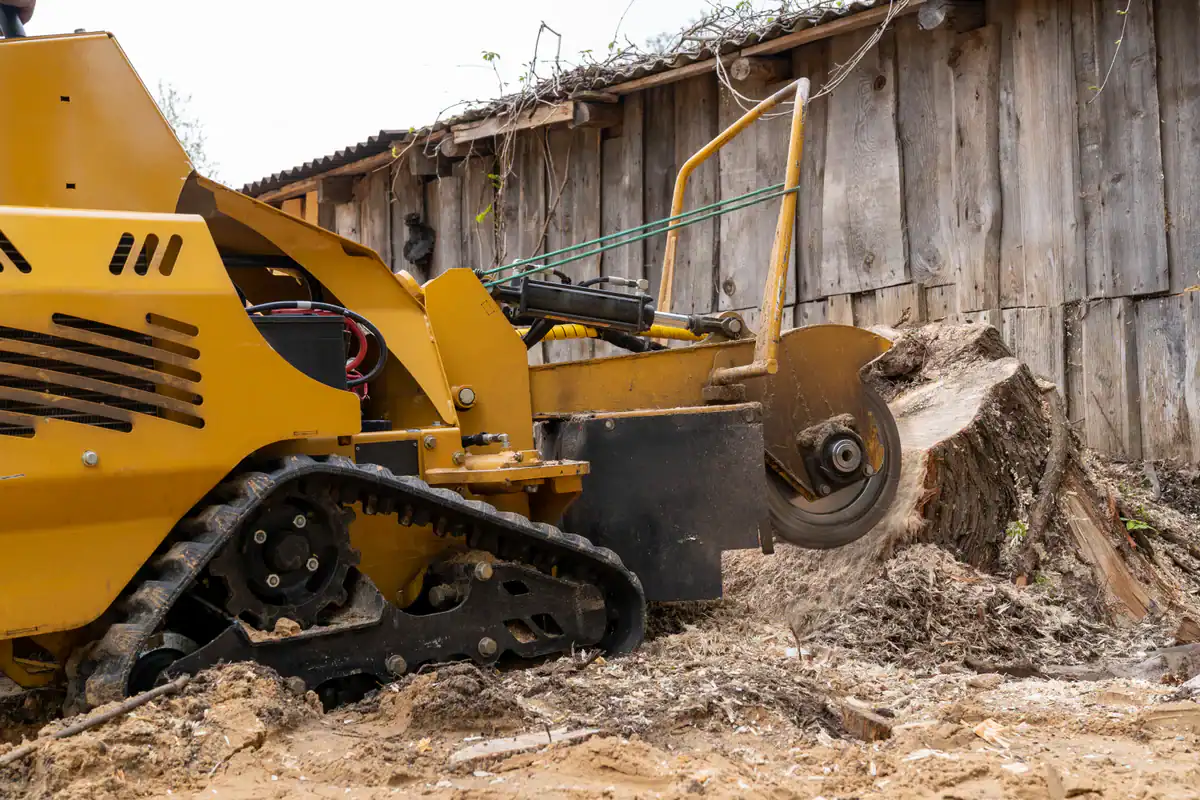
A few things drive quotes up, and they’re all legitimate. Stump diameter is the biggest factor, as the industry standard is to price by the inch, typically $2 to $6 per diameter inch. A 12-inch stump and a 36-inch stump represent completely different jobs, even if they’re the same species.
Species matters too. Hardwoods like oak, walnut, and ash take longer to grind than softer species. Kansas City has plenty of both, and the ongoing emerald ash borer situation has left a significant number of large, dense ash stumps across the metro that are harder and more time-consuming to work through than average.
Access is another real factor. If the stump is in a backyard with a narrow gate, on a steep slope, or close to a fence or foundation, getting equipment in safely takes more time and care. That shows up in the quote. A company that doesn’t account for access is either cutting corners or planning to surprise you later.
Finally, Kansas City’s clay soil adds a layer of complexity that doesn’t exist in every market. Dense clay makes grinding at depth more labor-intensive, and it affects how easily the area can be cleaned up and prepared for replanting afterward. We factor this into every assessment because it’s real work, and a company that doesn’t account for local soil conditions is giving you an incomplete quote.
It’s a reasonable question, especially when you’re looking at a quote and wondering if you could just handle it yourself over a weekend. Rental stump grinders are available, and the upfront cost, typically $150 or more for a four-hour window, looks attractive compared to a professional quote.
Here’s what that comparison usually misses. Rental machines are smaller and less powerful than professional equipment, which means they take significantly longer on anything larger than a small stump. A job we handle in an hour can take a homeowner most of a day with a rental machine. Add in the physical labor, the learning curve, and the logistics of hauling the machine to and from the rental location, and the value gap narrows fast.
There’s also the underground utility question. Before any stump grinding happens, 811, the national call-before-you-dig line, should be contacted so utility lines can be marked. Professional crews know this and do it as a matter of course. Homeowners renting equipment for a one-time job sometimes skip this step, creating real risk. A severed gas or electrical line is an expensive and dangerous outcome for a job that seemed straightforward.
For a small, easy-access stump in soft soil, DIY might make sense. For anything involving a large stump, a hardwood species, Kansas City clay, or proximity to structures, the professional route is almost always the better choice for both the final outcome and your Saturday.
The questions above cover most of what homeowners want to know before they pick up the phone. However, the most important question is simpler than any of them: who is performing the work, and do they understand what they are looking at?
There’s a real difference between a crew that shows up with a machine and a company where an ISA Certified Arborist is involved in the assessment. Certification means experience, ongoing education, and professional accountability, not just equipment access. It matters even for a job that looks mechanical on the surface.
If you’ve got a stump in your yard, regardless of whether it was left by a previous crew, came down in a storm, or has just been sitting there long enough, Squirrel Master Tree Services LLC is happy to take a look and give you a straight answer about what it’ll take. No pressure, no upsell, just an honest assessment from people who live and work right here in Kansas City, MO.
Summary:
Article details:
Share: