Most Kansas City homeowners assume stump grinding is entirely the crew's job. It is not, and skipping a few key steps can cost you more than you bargained for.
If you have got a stump sitting in your yard, used to being there two weeks or two years, you have probably already done the hardest part by deciding to deal with it. Now you are wondering what happens next. Most homeowners assume the answer involves simply waiting for the crew to show up. For the most part, that is true. However, a few things require your attention before grinding day that most tree companies never mention upfront. Skip them, and you roll the dice on your irrigation system, your invisible fence, or the job getting cut short. Here is what you need to know.
The biggest misconception homeowners hold is that stump grinding is entirely the contractor’s responsibility from start to finish. The grinding itself remains on us. Yet a short list of things requires your attention before we fire up the equipment, and those items matter more than most people realize.
The most important task involves calling 811. That serves as the national call-before-you-dig number, and it is free. When you call, utility companies come out and mark the public lines running through your yard, including gas, electric, water, and telecom lines. It typically takes two to three business days, so do not wait until the night before. If you have not called 811 before we arrive, we will not grind. It is that straightforward.
This next part catches a lot of Kansas City, MO homeowners off guard: 811 only marks publicly owned utility lines. It does not mark anything on your private property, which is where most of the real risk lives.
Your in-ground irrigation system? Not covered. The invisible dog fence wire running through your backyard? Not covered. The electrical line feeding your detached garage or backyard shed? Not covered. A secondary sewer lateral running to a guest house or outbuilding? Also not covered. These represent your lines, meaning locating and marking them before the crew arrives is your responsibility.
This is not a technicality. It is the most common way stump grinding jobs go sideways. Sprinkler lines rank as the single most frequently hit underground feature during stump grinding, and in Kansas City’s established suburban neighborhoods, in-ground irrigation is practically standard. If your yard has a system, walk the perimeter and flag every head you can find. Mark the main supply line if you know where it runs. If you are unsure, your irrigation company can usually perform a quick locate for a reasonable fee, and that is money well spent compared to the cost of repairing a severed line mid-job.
The same rule applies to invisible fence wire. It often runs in a loop close to the property edge, which is exactly where stumps from boundary trees tend to sit. A quick call to your fence company can secure a map of the wire path, or you can use the system’s transmitter to trace it manually.
Silver Maples, ranking among the most common trees in Overland Park, Prairie Village, and Shawnee, feature wide, shallow root systems that spread well beyond the canopy. That means the grinding zone is larger than it looks, and so is the risk of hitting something buried nearby. Taking 30 minutes to walk your yard and flag what you know is there is the single most valuable thing you can do before we show up.
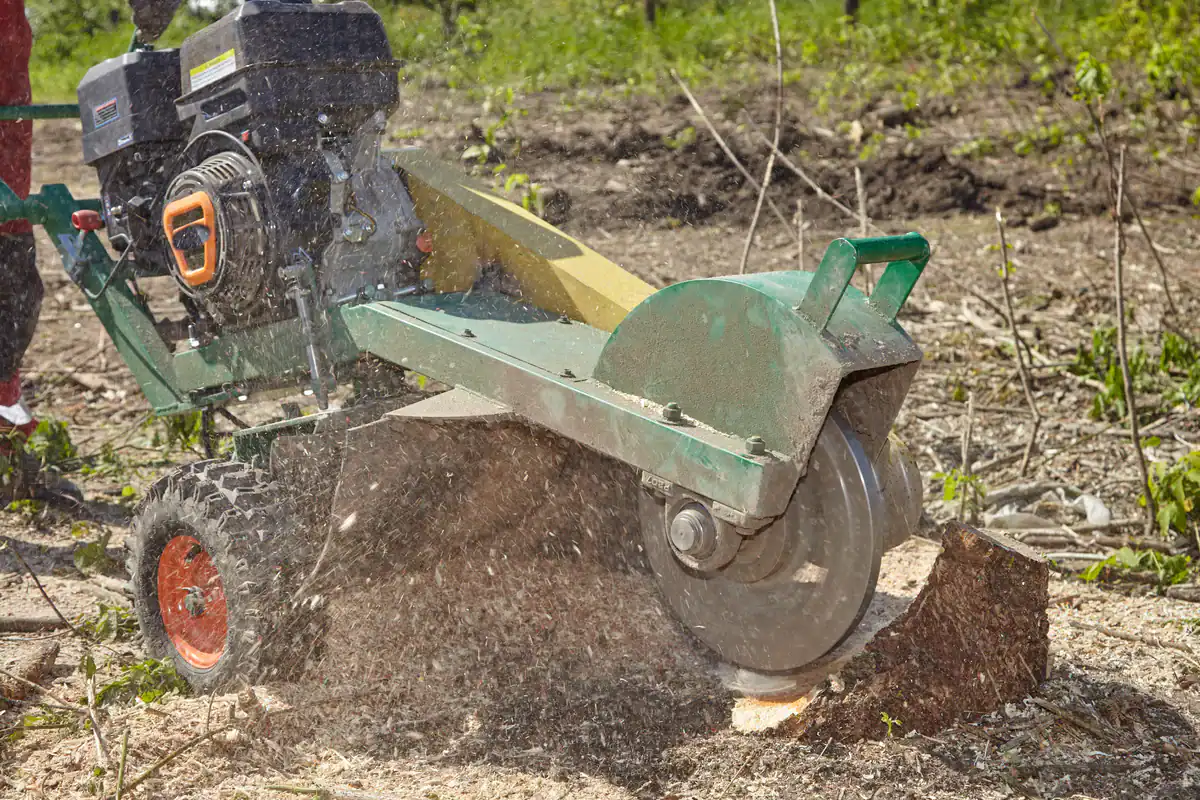
Once the underground items are handled, the next step involves giving the crew room to work. Stump grinders are heavy, purpose-built machines weighing over 1,000 pounds. They need a clear path to the stump and enough space to operate safely once they arrive.
Walk the area around the stump and remove anything that does not belong there. Garden hoses, lawn furniture, kids’ toys, potted plants, and decorative edging within a reasonable distance of the stump should move out of the way. Grinding throws wood chips and debris in all directions, and the last thing you want is a ceramic planter taking a hit from a flying chunk of root.
If the stump sits in your backyard, measure your gate opening before scheduling the job. Most residential stump grinders need a gate clearance of at least 36 inches, and some of the larger machines need closer to 48 inches. If access is tight, let us know when you call. We can plan around it, but we need advanced notice. Showing up to a job and discovering the equipment will not fit through the gate wastes everyone’s time and delays your project.
It also helps to mow or trim any tall grass or weeds around the base of the stump before we arrive. Overgrown vegetation makes it harder to see what we are working with and obscures surface roots, sprinkler heads, or other features we need to spot during our pre-grind walkthrough. A clear, visible work zone results in a faster, cleaner job.
If your stump comes from a tree downed in a storm, a common scenario here given Kansas City’s spring weather, check if debris, broken branches, or buried root fragments remain in the surrounding area. Storm-felled trees often leave a messier footprint than cleanly removed ones, and clearing that out beforehand helps the job proceed smoothly.
Want live answers?
Connect with a Squirrel Master Tree Services LLC expert for fast, friendly support.
Many homeowners have never watched stump grinding happen up close, and the uncertainty regarding the process can cause nervousness about booking. Here is the honest version of how it works.
We start with a site walk. Before any equipment runs, we walk the property with you, confirm the stump location, identify hazards that were not visible from the street, and agree on the scope of work. This is when the pre-grinding prep you performed pays off. If the lines are marked and the zone is clear, this walkthrough goes quickly, allowing us to start immediately.
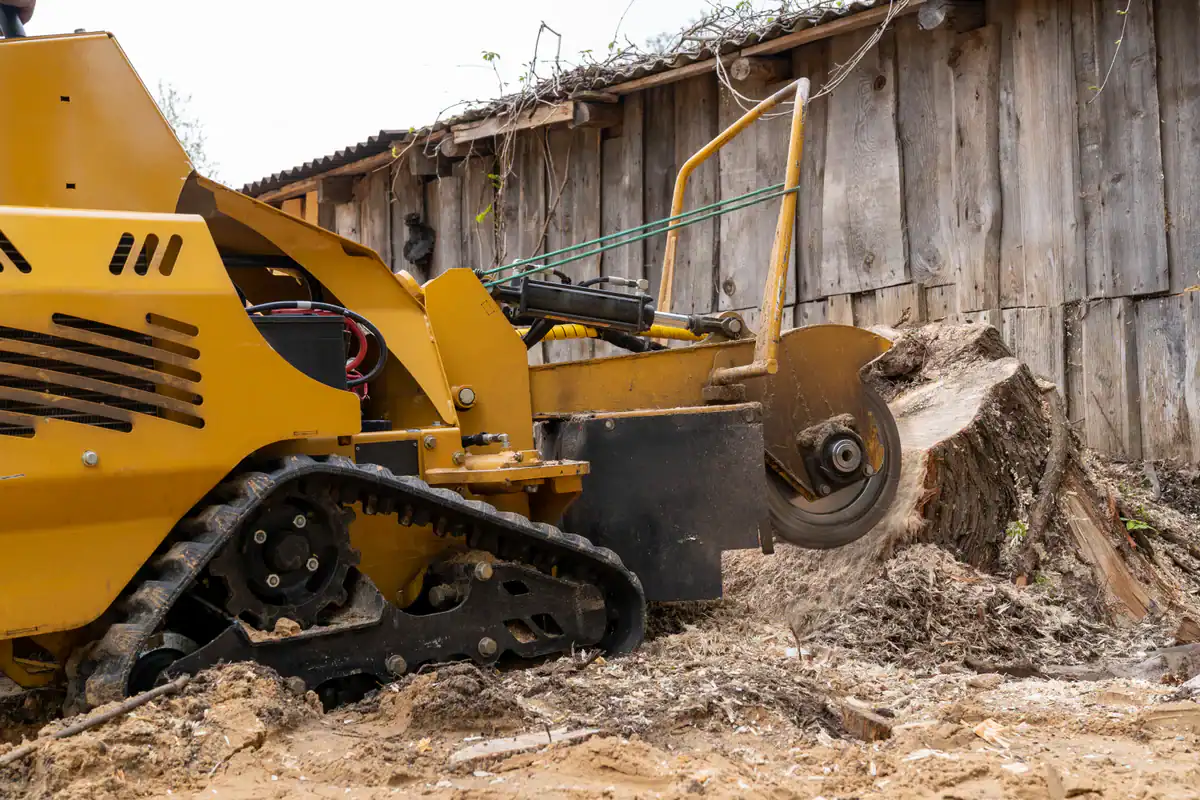
Standard professional stump grinding goes six to eight inches below grade, which is deep enough to fill the hole, lay topsoil over it, and grow grass without the stump interfering. That depth serves as the industry benchmark and guides our work on every job.
It does not remove the entire root system. The lateral roots spreading out from the base of the stump remain underground and decompose naturally over time. For most residential applications, that is completely fine since the roots do not cause problems for your lawn or foundation. If you plan new construction over the area, that represents a different conversation, and full stump extraction may make more sense. However, for the vast majority of Kansas City homeowners wanting a clean yard, grinding to depth is the right call.
The regrowth question is worth addressing directly because it comes up often. For most tree species, grinding the stump stops regrowth completely by cutting off the root system’s ability to send energy to the surface. A few species, with Silver Maple being the most common in Kansas City, can still push up new shoots from deep lateral roots even after grinding. If your stump comes from a Silver Maple, mention it when you call. It is not a dealbreaker, but knowing beforehand lets you watch for sprouts and address them quickly if they appear.
In Kansas City’s heavy clay soil, post-grinding restoration takes a bit more attention than it would in lighter soil. Clay drains less readily, so filling the hole correctly matters. Once grinding concludes, the cavity remains full of wood chips. You can leave them as mulch, or we can discuss disposal. If you plan to reseed the area, you should mix the chips with topsoil and let the area settle before seeding. Clay soil compacts differently than sandy or loamy soil, and giving it time to settle beforehand reduces the chance of uneven settling later.
After grinding concludes, the stump cavity fills with a mix of wood chips and soil. This generates one of our most common questions, and the answer depends on your plans for the space.
If you are not in a rush to replant or reseed, the wood chips can stay right where they are. They break down over time and improve the soil as they decompose. Some homeowners rake them out and spread them around garden beds as mulch, which works well and keeps them from going to waste. If you want them gone entirely, we can discuss hauling them away, though that decision needs to be made before the job starts so we can plan accordingly. Do not assume chips automatically undergo removal unless it is explicitly part of your agreement.
For homeowners wanting to reseed the area, timing matters. Wood chips decompose by pulling nitrogen out of the soil as they break down, which is not ideal for new grass seed. The standard approach involves raking out as many chips as possible, filling the hole with quality topsoil, which is especially important in Kansas City where native clay provides little for grass roots, and then seeding once the area has been watered and allowed to settle. Most homeowners can expect to reseed within a few weeks of grinding, depending on stump size and fill settlement.
If your stump came from a large hardwood, such as a bur oak or pin oak common in Kansas City’s older neighborhoods, the hole will be deeper and wider than average, and the settling process takes longer. Allowing some time to pass before declaring the project finished prevents the need to reseed twice.
If you live in a neighborhood with homeowner association rules requiring stump removal after tree work, keep a copy of your service agreement as documentation of job completion. Some HOAs in the Kansas City metro enforce specific timelines and request proof of compliance. It is a small detail, but worth keeping in your files.
Prepping your yard for stump grinding is straightforward, though it requires a little legwork on your end. Doing it right makes a real difference in how the job proceeds. Call 811 a few days out, mark your private lines, clear the work zone, know your gate width, and decide what to do with the chips. That covers most of it.
When you are ready to move forward, Squirrel Master Tree Services LLC offers free estimates across the Kansas City metro on both sides of the state line. Our owner is an ISA Certified Arborist with over 15 years of experience working in this specific market, meaning the person assessing your stump is not a salesperson or a subcontractor. It is someone who knows Kansas City’s soil, tree species, and neighborhoods firsthand.
If you have got a stump ready for removal, reach out. We will walk the yard with you, explain what is involved, and provide a clear, written estimate before any work begins.
Summary:
Article details:
Share: