
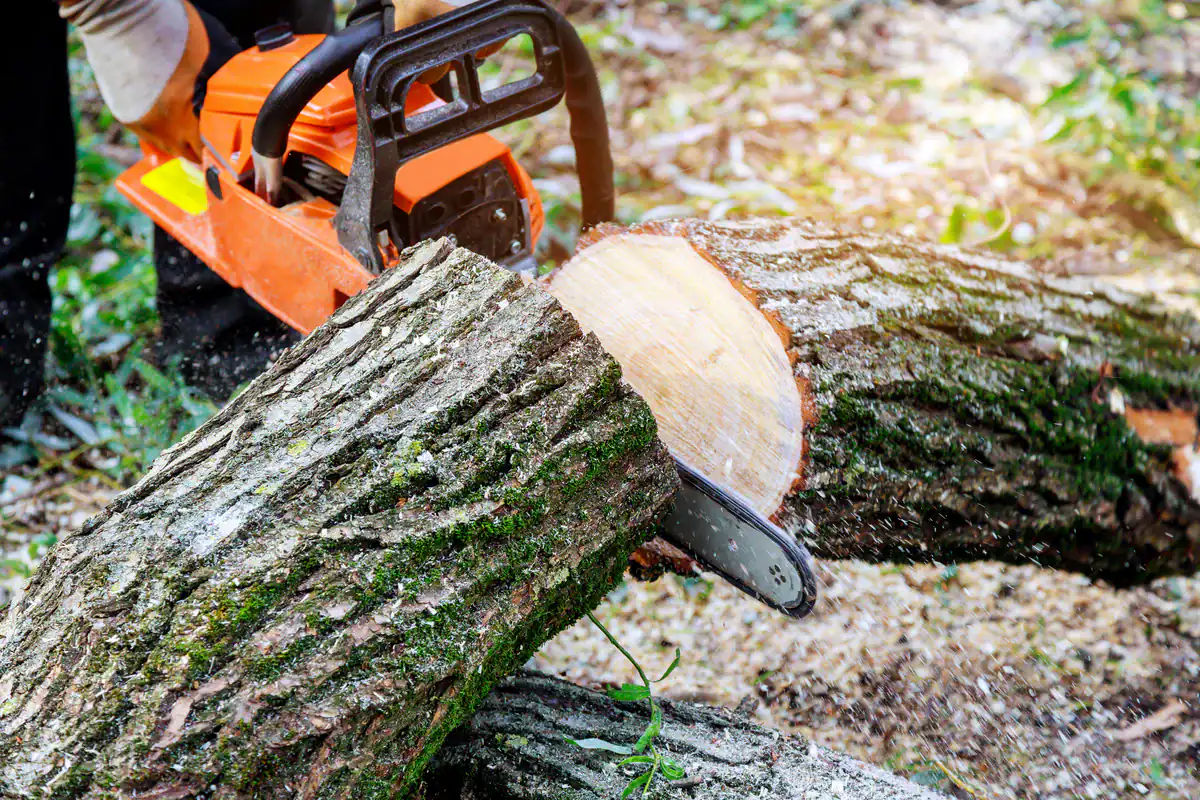
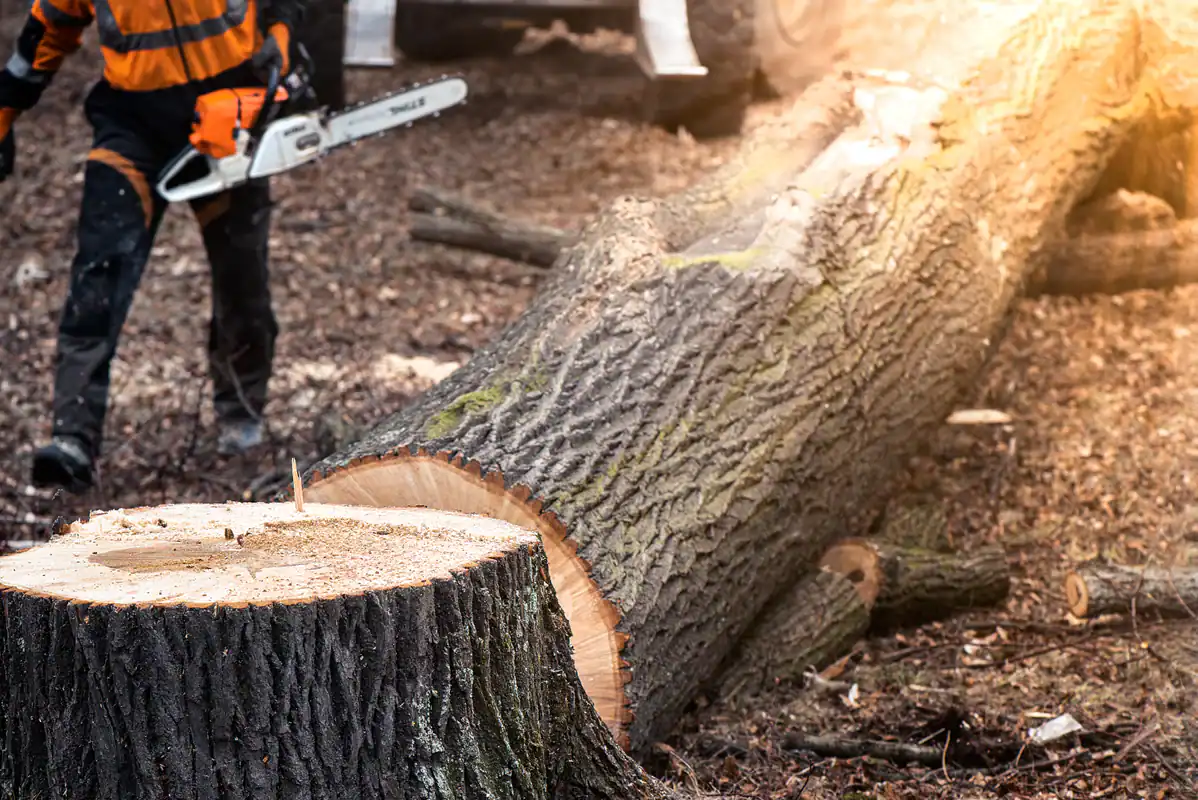
A tree that’s been through one too many Kansas River flood cycles doesn’t always show it on the outside. The roots lose their grip in saturated clay long before the tree starts to visibly lean. By the time there’s an obvious sign something is wrong, the risk to your house, your fence, or your neighbor’s yard is already real. Getting a professional set of eyes on it — and getting the tree down safely when it needs to come down — is what keeps a manageable situation from turning into an expensive one.
For homeowners in De Soto’s established neighborhoods like Timber Trails, Cherished Oaks, and Heritage Hills, that means dealing with mature hardwoods that have had decades to grow close to structures, driveways, and property lines. These aren’t small jobs. They require a crew that knows how to work in tight residential spaces without turning your yard into a disaster zone.
Every job we complete includes full cleanup — no wood piles left behind, no chip piles sitting in your grass. If you want to keep the wood for firewood or the mulch for your beds, just say so upfront. Otherwise, it’s gone when the crew leaves.
That combination — safe removal in tight spaces and a genuinely clean finish — is what most homeowners in De Soto are actually looking for. Not a sales pitch. Just a crew that handles the problem and leaves the property better than they found it.
We’ve been working across the Kansas City Metropolitan Area, MO metro for over a decade. Our crew is Kansas-raised and already active throughout Johnson County — Lenexa and Olathe are confirmed service areas, and De Soto is the natural next stop west on K-10. That’s not a stretch of our service area. That’s the same corridor, the same soil conditions, and the same storm patterns we’ve been navigating for years.
This is a family-owned operation, not a franchise dispatching strangers from a call center. When you call for an estimate, you’re dealing with people who actually work the jobs — people who know what Johnson County clay does to root systems after a wet spring, and who have handled large-scale storm recovery not just here in Kansas and Missouri, but across North Carolina, South Carolina, and Florida. That kind of experience doesn’t come from doing a handful of residential removals a week.
We’re fully licensed and insured, carrying both liability coverage and workers’ compensation. In a community growing as fast as De Soto is right now, with new neighbors and new construction pushing up against established properties, that protection matters more than most homeowners stop to think about.
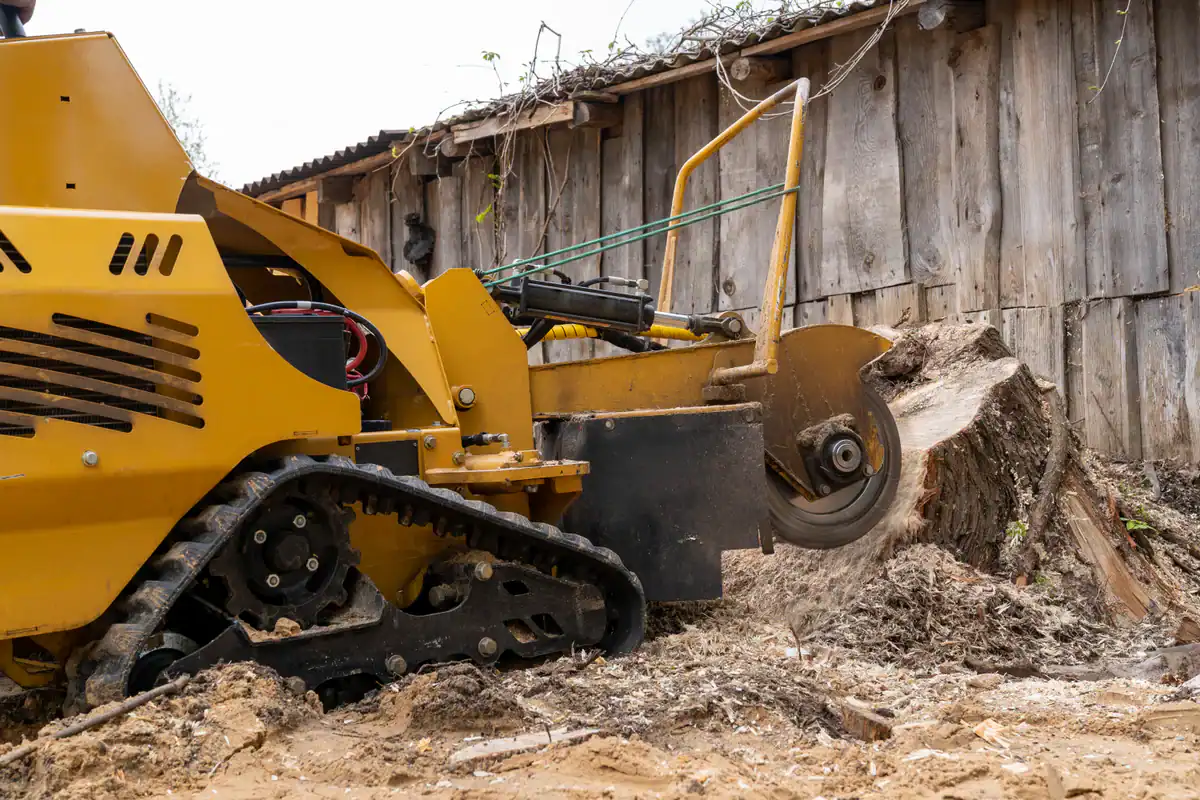
It starts with a free estimate. Someone comes out, looks at the tree in person, and gives you a straight read on what it actually needs. If a strategic trim can solve the problem, that’s what you’ll hear — not a push toward full removal. If the tree needs to come down, you’ll know why, and you’ll know what the job involves before anyone picks up a chainsaw.
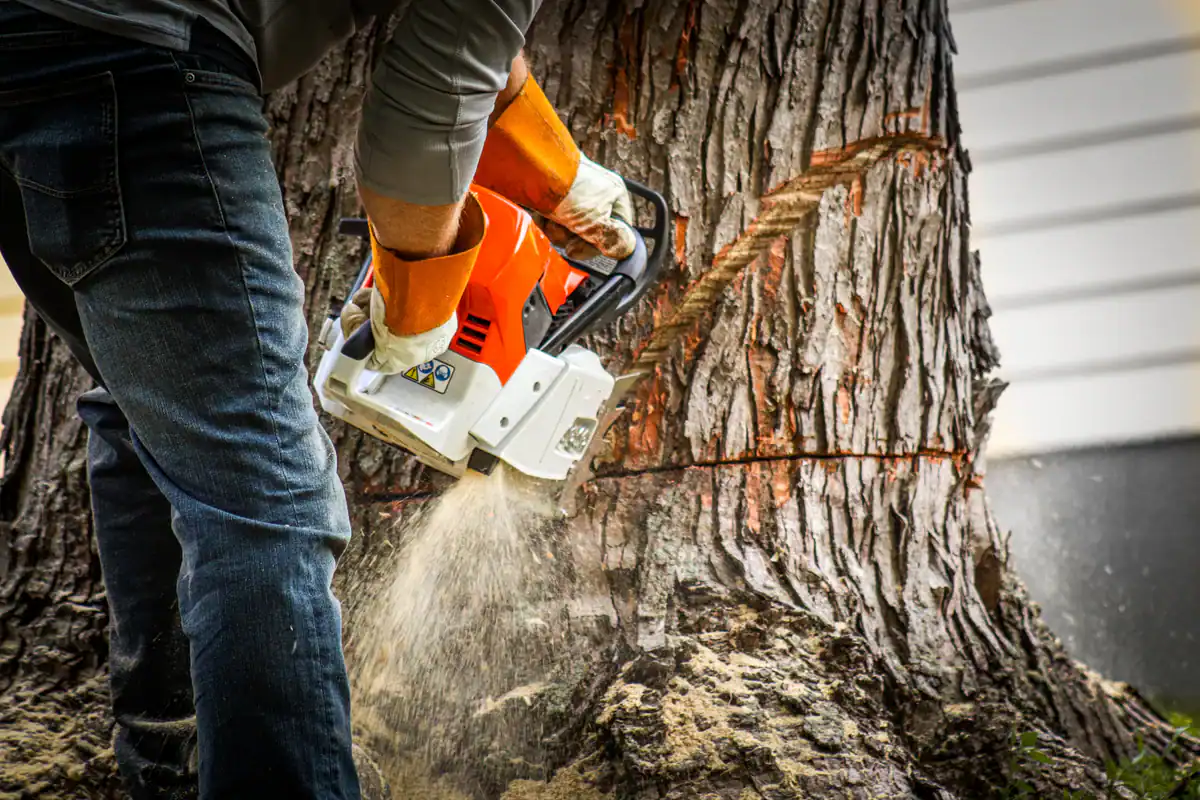
Once you’re ready to move forward, we schedule the work and get it done. For most residential removals in De Soto, that means working carefully around structures, fences, and neighboring properties — something that comes up constantly in the older parts of town where mature oaks and cottonwoods have had decades to grow into tight spaces. We section the tree down in a controlled sequence, managing each cut to direct where material falls. Nothing gets left to chance near a house or a fence line.
One thing worth knowing specific to De Soto: if your tree is near the public right-of-way or a city street, De Soto’s municipal code gives the city authority over those trees. We can help you understand what’s on your property versus what falls under city jurisdiction before any work starts — so there are no surprises after the fact. When the job is done, we clear the site completely. You get your yard back, not a pile of debris to deal with on your own.
Ready to get started?
Tree removal in De Soto isn’t a one-size situation. Along the Kansas River corridor, you’re dealing with fast-growing bottomland species — cottonwood, silver maple, river birch — that develop large canopies quickly and can become structurally compromised after a flood season. In the established subdivisions further from the river, it’s mature oaks, elms, and hackberries that have been growing for thirty or forty years, often within a few feet of a structure. Both scenarios require a different approach, and we’ve worked through both.
Every removal includes the full scope: cutting the tree down safely, removing the trunk and all debris from the site, and leaving the ground clean. Stump grinding is available if you want the stump taken care of at the same time — worth doing if you’re planning to reseed or replant the area. Brush removal is also available for properties dealing with overgrowth beyond a single tree.
If you’re in one of De Soto’s newer developments like Arbor Ridge and dealing with trees at the edge of a newly developed lot, that kind of clearing work is something we handle regularly. For diseased tree removal — whether you’re dealing with Emerald Ash Borer damage, Oak Wilt, or general decline from flood stress — the process starts the same way: an honest assessment of whether the tree can be saved or needs to come down. Dead tree removal and hazardous tree removal follow the same full-service approach, with cleanup included every time. No partial jobs, no piles left behind.
This is the right question to ask before calling anyone, and the honest answer is that it depends on what’s driving the concern. A tree that’s lost less than about a quarter of its branch structure from storm damage or disease may still recover with proper trimming and care. But a tree that’s structurally compromised — leaning after a wet season, showing significant dead wood through the upper canopy, or showing signs of root failure — is a different situation entirely.
In De Soto specifically, the combination of heavy Johnson County clay and proximity to the Kansas River creates conditions where trees can lose root stability without showing obvious above-ground signs right away. A tree that looks mostly healthy after a flood season may have compromised anchoring at the root level. That’s not something you can assess from the ground with confidence. A professional on-site estimate — which we provide at no charge — gives you a real answer based on what the tree actually looks like, not a guess made over the phone.
It depends on the situation, and the details matter more than most people realize. If a tree falls during a storm and damages a covered structure — your house, your garage, a fence — most homeowners insurance policies will cover some portion of the removal cost, typically in the range of $500 to $1,000 specifically for the removal itself. The structural damage is usually covered separately under your dwelling coverage.
Where it gets complicated is when a tree was already dead, visibly diseased, or leaning before it fell. If your insurer can show that you knew the tree was a hazard and didn’t address it, they may deny the claim based on negligence. This isn’t a rare outcome — it’s a standard clause in most policies. De Soto’s position along the Kansas River means flood stress and root destabilization are real, recurring conditions here. A tree that’s been through multiple high-water events may be more compromised than it looks. Proactive removal before a storm takes it down is almost always the less expensive path, and it keeps your insurance coverage intact.
Tree removal pricing varies based on the size of the tree, its location relative to structures and utilities, and how complex the removal is. In the Kansas City Metropolitan Area, MO area, most residential tree removals fall somewhere between $300 and $3,500, with the wide range reflecting everything from a small ornamental tree in an open yard to a large oak growing close to a house or power line.
We don’t publish fixed pricing because every job is genuinely different — a large cottonwood along the Kansas River corridor in De Soto with roots in saturated clay is a different job than a medium-sized tree in an open backyard in Arbor Ridge. What you will get is a free, in-person estimate with a straightforward number before any work starts. No surprise charges after the fact, no pressure to add services you didn’t ask about. The estimate reflects the actual job, and that’s the price.
For most standard residential tree removal on private property in De Soto, there is no city permit required. Kansas municipalities generally do not require homeowners to obtain permits for removing trees on their own land, and De Soto’s city code doesn’t include a specific private-property removal permit requirement for standard situations.
Where it gets more specific is with trees near or within the public right-of-way. De Soto’s city code does require a right-of-way permit for trimming trees in the ROW, and the city has authority over trees adjacent to public streets and alleys. If your tree is close to the road or a sidewalk, it’s worth confirming whether it’s on your property or within the city’s jurisdiction before any work starts. We can help you sort that out during the estimate visit so you’re not caught off guard. City-owned trees are the city’s responsibility — and the city can also require you to remove a hazardous tree near public property and bill you if you don’t comply.
The stump doesn’t go away on its own — at least not quickly. Left in place, a stump will take years to fully decay, and in the meantime it can become a tripping hazard, attract insects, and make mowing and landscaping around it a recurring hassle. In Johnson County’s heavy clay soil, stumps also tend to hold moisture longer than they would in sandier ground, which can encourage fungal growth and slow the decomposition process even further.
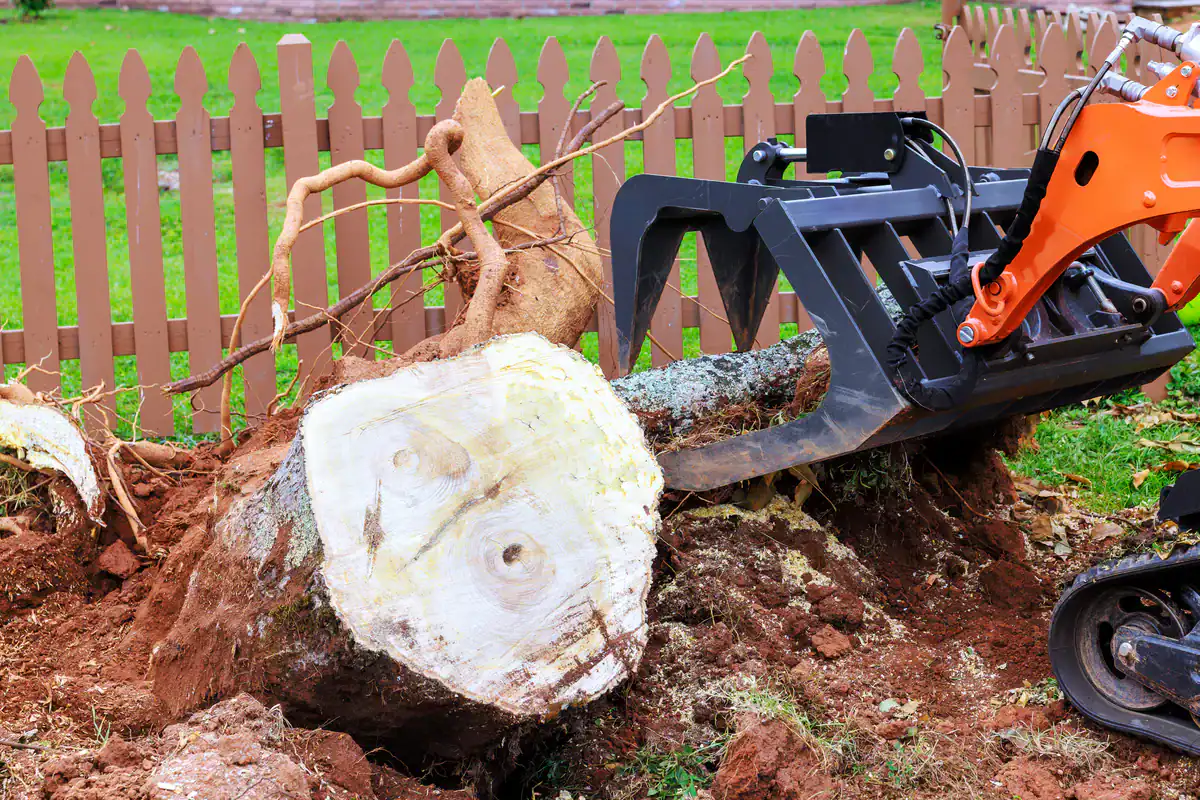
Stump grinding is the most practical solution for most homeowners. The grinder reduces the stump to wood chips a few inches below grade, which you can then cover with soil and reseed or replant over. It’s not the same as full stump removal — the root system stays in the ground — but for most residential situations in De Soto, it’s the right call. If you’re in a newer development like Arbor Ridge and planning to landscape the area after removal, stump grinding at the same time as the tree removal is the most efficient approach. We handle stump grinding as part of the same job when requested — just ask during the estimate.
De Soto sits in a part of Johnson County that gets hit by real weather — spring severe thunderstorms, tornado watches, summer wind events, and winter ice loading are all part of the annual cycle here. When a storm comes through and leaves a large limb hanging over your roof or a tree leaning toward your fence, waiting a week for someone to show up isn’t an option.
We’re already active throughout the K-10 corridor in Johnson County, with Lenexa and Olathe as confirmed service areas directly east of De Soto. That means we’re not driving in from across the metro — we’re already nearby. Multiple customers have confirmed same-day or next-day estimates and rapid scheduling after storm events. Beyond local response, we’ve deployed to large-scale storm recovery operations across multiple states, which means we’re not learning how to handle high-volume, post-storm situations on your job. If you have a genuinely hazardous situation after a storm — a tree on a structure, a hanging limb over a living area, a leaning trunk near a neighbor’s property — call as soon as you can. The sooner we can assess it, the sooner it gets handled safely.
Other Services we provide in De Soto