
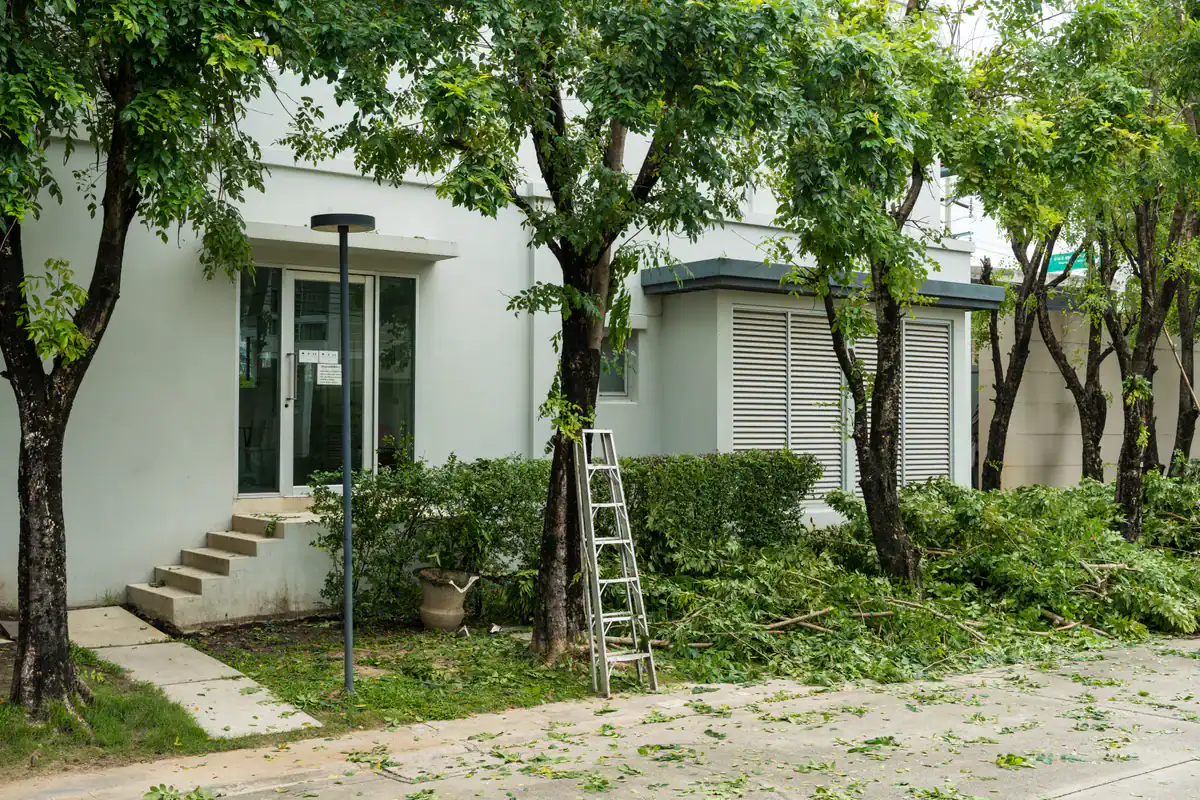
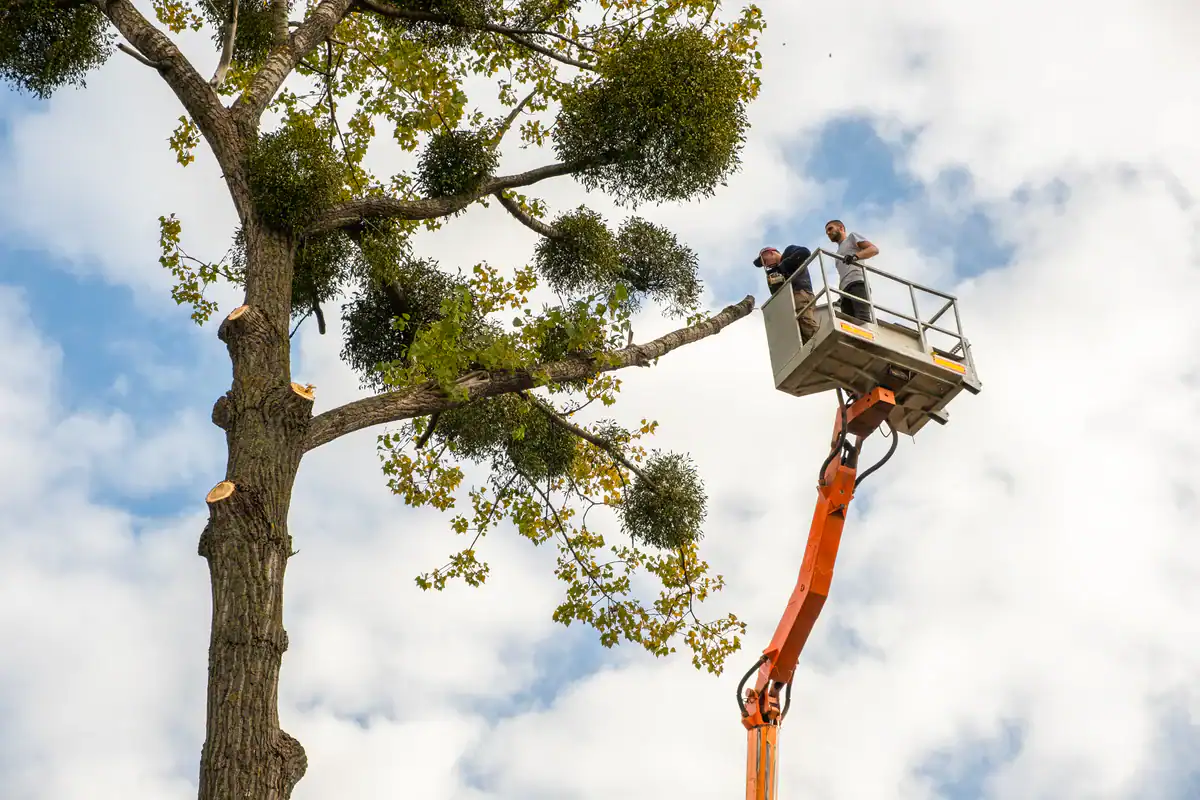
De Soto sits in the Kansas River valley, and that setting produces some of the most established tree canopy in Johnson County. Mature cottonwoods, oaks, and hackberries have been growing for decades and look impressive — until one develops a hollow trunk, a compromised root system, or a major limb that’s one spring storm away from coming down on your fence, roof, or neighbor’s car.
Getting ahead of that is a lot easier than dealing with the aftermath. When you call us, you get a clear picture of what’s actually going on with your trees before anything gets cut. If a trim handles it, that’s what we recommend. If removal is the right call, the job gets done cleanly, safely, and completely — including full debris cleanup. No piles left in your yard, no wood chips scattered across the driveway.
Johnson County’s severe weather season runs hard through spring and into summer. Tornado watches and thunderstorm wind gusts in the 60–75 mph range are a documented reality for De Soto. Trees that are already stressed, diseased, or structurally compromised don’t need much encouragement to fail during those events. Staying ahead of that risk isn’t just about aesthetics — it’s about protecting what you’ve built here.
We’ve been working across the Kansas City, KS & MO metro for over ten years. Our crew is small, the work is personal, and the record speaks for itself — 1,200+ trees removed without a single safety incident. That’s not a marketing line. It’s what happens when a tight-knit crew takes the work seriously every single time.
We’re fully licensed under Kansas’s arborist licensing requirement and fully insured — liability and workers’ compensation both. That matters in De Soto, where real estate values rank among the highest in Kansas and where a careless crew can cause damage that costs far more than the job itself. You’re not dealing with a dispatch queue or a national call center. You’re dealing with real people who know this area.
Whether you’re a longtime De Soto resident with mature trees that have never been professionally assessed, or someone new to the area who just relocated for work and inherited a property full of unknowns, our approach is the same — honest evaluation, clear recommendation, and work that gets done right the first time.
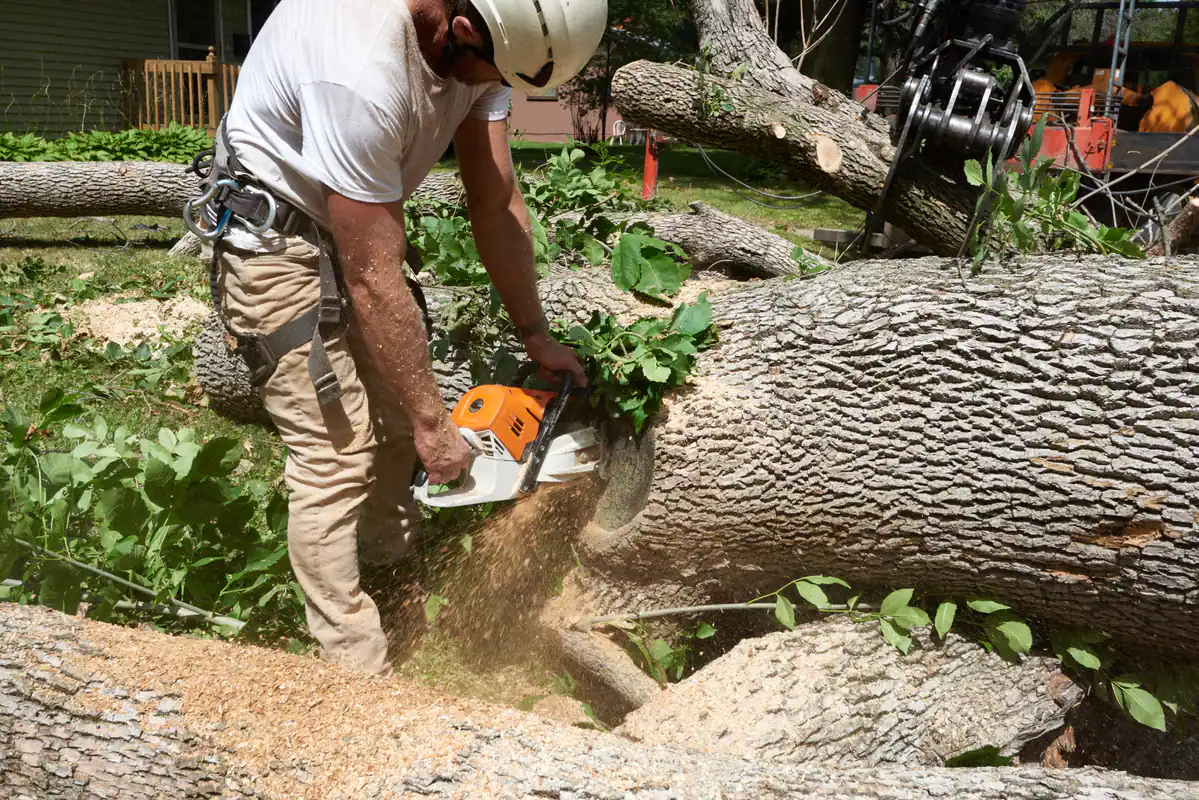
It starts with a free estimate, and most of those happen the same day you call. A crew member comes out to your property, looks at the tree or trees in question, and gives you a straight answer about what’s going on. If there’s a hazard, you’ll hear about it plainly. If the tree is fine and just needs a trim, that’s what we recommend. No pressure to do more than what’s actually needed.
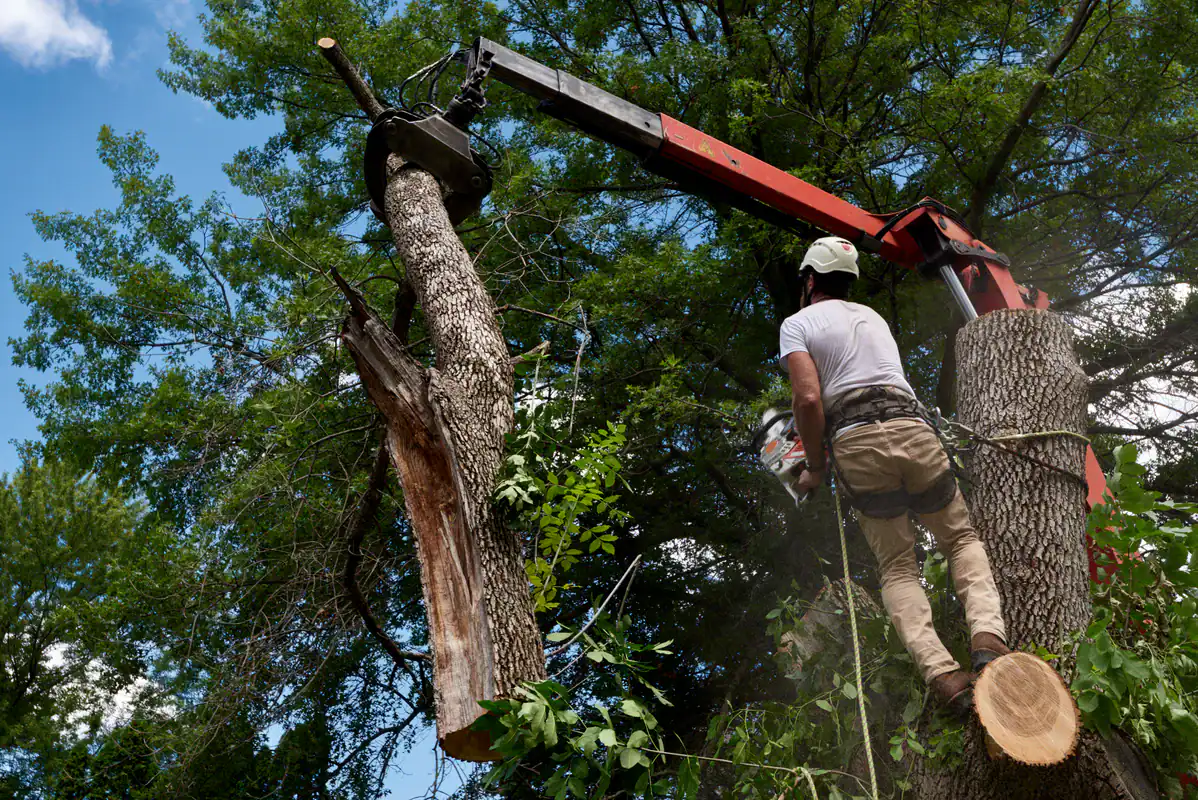
Once you decide to move forward, we schedule the job and show up with everything required to handle the work safely. For De Soto properties — especially those in the older residential areas near the Kansas River corridor — that often means navigating mature hardwoods in tight spaces, close to structures, fences, and neighboring lots. Our 100% safety record across 1,200+ removals reflects exactly the kind of careful, methodical work that those situations require.
After the tree work is complete, cleanup is part of the job — not an add-on, not an extra charge. Every branch, every wood chip, every piece of debris gets cleared from your property. If you want to keep the wood or mulch for personal use, just say so. Otherwise, it all goes with us. De Soto’s building code requires that all trees and brush material generated during clearing be removed from the site, and that standard applies to every job we complete here — residential or otherwise.
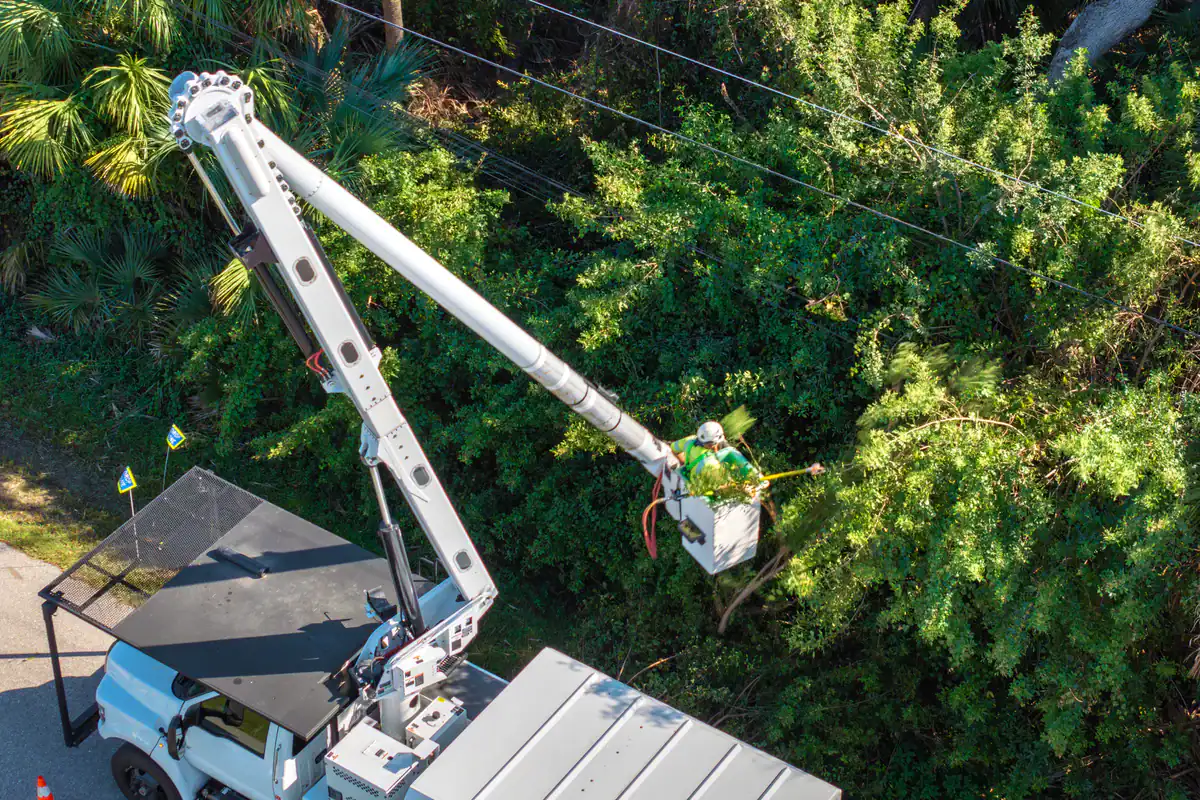
Ready to get started?
Tree removal is the most visible service, but it’s rarely the only one a property needs. We handle the full range of residential tree care in De Soto — trimming and pruning to keep trees healthy and shaped correctly, stump grinding to clear what’s left after a removal, land clearing for properties being prepared for new construction, and on-site tree health assessments for homeowners who aren’t sure what they’re dealing with.
That last one matters more in De Soto right now than it might in a more settled suburb. With the Panasonic facility bringing new residents into the area and the former Sunflower Army Ammunition Plant site actively being redeveloped along the K-10 corridor, new construction is changing drainage patterns, compacting soil, and altering the conditions that established trees have grown in for decades. Trees that looked fine two years ago may be under stresses they haven’t experienced before. A professional assessment catches that before it becomes an emergency.
Stump grinding is worth calling out specifically because a lot of homeowners assume it’s included in tree removal — it typically isn’t, and it’s quoted separately. We’re upfront about that from the first conversation. No named service packages, no hidden line items. You get a clear quote that covers exactly what’s being done, and you know what you’re paying for before any work begins.
This is the question most homeowners in De Soto are really asking when they call. The honest answer is that you often can’t tell just by looking. Internal decay, root damage, and structural weakness don’t always show up on the surface. A tree can look completely healthy from the outside and still be hollow through the center or compromised at the base.
The signs that warrant a professional look include visible leaning that wasn’t there before, large dead branches in the upper canopy, fungal growth at the base of the trunk, cracks or splits in major limbs, and bark that’s peeling or falling away in unusual patterns. In De Soto, the mix of mature hardwoods and fast-growing softwoods common to the Kansas River valley corridor means you’re dealing with species that age and fail in different ways. A cottonwood behaves very differently than a mature oak as it declines.
The safest first step is a free on-site assessment. We’ll come out, evaluate the tree, and give you a plain answer — not a sales pitch. Sometimes a strategic trim resolves the issue entirely. Sometimes removal is the right call. Either way, you’ll know exactly what you’re working with before you make any decision.
Storm response is one of the most time-sensitive situations in tree care, and De Soto sits squarely in a part of Johnson County that sees serious severe weather. Tornado watches and documented thunderstorm gusts in the 60–75 mph range are a regular feature of spring and early summer here. When a major limb comes down or a tree leans toward a structure after one of those events, waiting several days for a callback isn’t an option.
We offer same-day emergency visits for urgent situations. The standard response time is within 24 hours, but for storm damage that poses an immediate risk to your home or property, we aim to get someone out the same day. That kind of availability matters most in the hours right after a storm, when the risk of further damage — from a compromised root system, a partially fallen tree still under tension, or a limb hanging over a power line — is at its highest.
One thing worth knowing: after a major storm event in the Kansas City, KS & MO metro, the area tends to attract door-to-door solicitors offering quick-fix tree work. These operators often lack proper licensing and insurance. Kansas requires an arborist license for tree work, and working with an unlicensed crew puts the liability on you as the property owner if something goes wrong. Stick with a licensed, insured company — and ask to see proof before any work begins.
It’s a separate service, and it’s worth understanding why before you get a quote. Tree removal and stump grinding are two distinct jobs that require different equipment. When a tree is removed, the stump — typically cut close to ground level — stays in place unless grinding is specifically requested and quoted. A lot of homeowners assume the stump goes with the tree, and then they’re surprised when it doesn’t.
We’re upfront about this from the first conversation. Your estimate will clearly show whether stump grinding is included or priced separately, so there are no surprises after the crew leaves. The reason it matters is practical: a leftover stump isn’t just an eyesore. It can attract wood-boring insects, become a tripping hazard, put out new growth shoots from the root system, and get in the way of replanting or lawn work in that area.
For De Soto properties where you’re dealing with large, established hardwoods — the kind of mature oaks and cottonwoods common in the older residential areas near the Kansas River — the stump left behind after removal can be substantial. Grinding it down properly takes the right equipment and experience. If you’re clearing a lot for new construction or landscaping, full stump removal is almost always the right call, and it can be quoted and scheduled alongside the tree removal itself.
For most standard residential tree removals on private property in De Soto, there is no homeowner permit requirement based on the city’s current municipal code. The city’s tree ordinance — Article 3 of De Soto’s municipal code — primarily governs trees in public rights-of-way and city parks. Removing a tree from your own residential lot generally does not require you to pull a permit before the work begins.
That said, there are a couple of situations where the rules shift. If you’re clearing trees as part of a construction project, De Soto’s building code requires that all trees and brush material generated during that clearing be completely removed from the site — so the scope of the work matters. And if the city has issued you a compliance notice about a hazardous tree, there may be a specific timeframe and process attached to that notice that affects how and when the work needs to happen.
If you’re unsure whether your specific situation triggers any local requirements, the safest approach is to ask before the crew starts. We can walk you through what’s typical for the type of job you’re doing and flag anything that might need a closer look before work begins. When in doubt, a quick call to De Soto’s city offices can confirm the current requirements for your specific property and situation.
The general industry guideline is every three to five years for most established trees, but that’s a starting point — not a fixed rule. The right interval depends on the species, the age of the tree, its location on the property, and what’s happening around it. A fast-growing softwood in a yard near new construction may need attention more frequently than a slow-growing mature oak that’s been stable for decades.
In De Soto, a few local factors push that timeline earlier for some properties. The severe weather season here is real — spring storms with high winds can stress branches that are already overextended or weakly attached. Trees that haven’t been trimmed in several years tend to develop heavier, longer limbs that become more vulnerable to wind loading. Getting ahead of that before storm season is a better approach than dealing with the damage after.
The other factor worth considering in De Soto right now is the development activity along the K-10 corridor. New construction nearby can change the drainage and soil conditions that established trees depend on. A tree that was thriving two years ago may be showing early signs of stress that aren’t obvious yet. An annual or biennial professional assessment — even if no trimming is needed — gives you a current picture of what’s going on before a problem develops into a hazard.
This is a real concern in the Kansas City, KS & MO metro, and De Soto is not immune to it. After significant storm events, the area sees an influx of operators who show up door-to-door, offer fast work at low prices, and move on before any problems surface. Some of these crews are unlicensed, uninsured, or both — and if something goes wrong on your property, the financial and legal exposure falls on you as the homeowner.
Kansas requires an arborist license for tree work. That’s a state-level requirement, not a suggestion. Before any crew starts work on your property, ask to see proof of their license and their insurance certificate — specifically liability insurance and workers’ compensation. A legitimate company will have both and won’t hesitate to provide documentation. If someone can’t produce either on request, that’s a clear signal to walk away.
Beyond documentation, a few practical checks help: look for verifiable online reviews with real names and specific job details, confirm the company has a local address and a working phone number, and get your estimate in writing before any work begins. We’re fully licensed in Kansas, fully insured, carry a 4.9-star rating across 40 verified reviews, and have completed over 1,200 tree removals in the Kansas City, KS & MO area without a single safety incident. That’s the kind of track record that’s worth verifying — and easy to do before you commit to anything.
Other Services we provide in De Soto