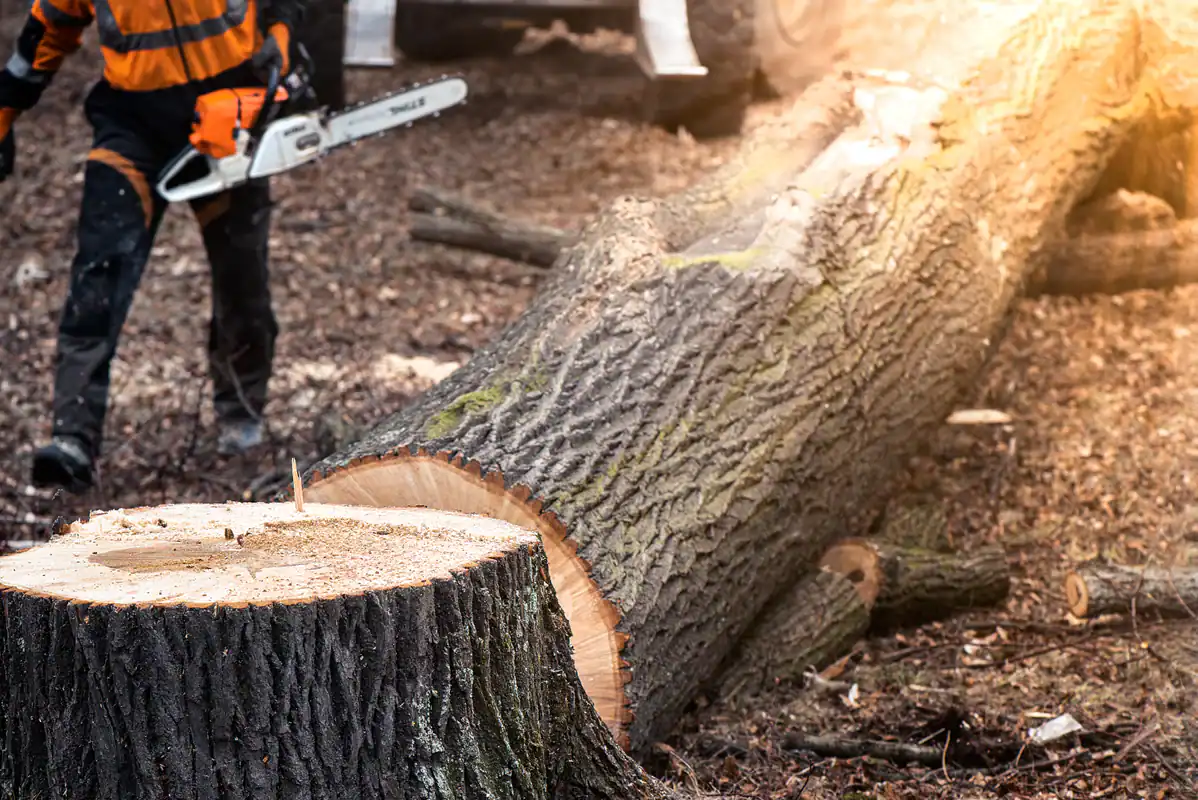
When a tree comes down the right way, you stop worrying. That’s really what this comes down to — not the tree itself, but the weight of knowing it’s there, leaning toward your roofline or dropping heavy limbs every time a storm rolls through Leavenworth County.
Basehor gets hit. The area has been under severe weather warnings more than 50 times in the past year alone, with documented wind gusts reaching 80 mph in the region. For homeowners in newer subdivisions along 158th Street or in the Falcon Lakes community, that’s not an abstract risk. The trees planted when those neighborhoods were developed are now mature enough to cause real damage — and many are already showing signs of stress, disease, or structural failure.
After a proper removal, that changes. The dead ash tree that’s been dropping branches near your driveway is gone. The storm-damaged oak that’s been leaning toward your fence is handled. Your yard is clean — no piles, no debris, no chips scattered across your lawn. If you want to keep the wood or mulch, we’ll arrange that. If you just want it all gone, it will be.
Squirrel Master Tree Services, LLC is a licensed, insured, Kansas-based tree crew with over a decade of experience working across the Kansas City, KS & MO metro — including Leavenworth County and Basehor specifically. This isn’t a franchise or a call center dispatching strangers. We’re a tight-knit team raised in Kansas that treats every property like our own.
We’ve handled tree removal in residential neighborhoods, on commercial properties, and as part of large-scale storm recovery operations across multiple states. That experience matters when you’re dealing with a large hazardous tree in a tight Basehor subdivision lot, close to a fence line or a neighbor’s yard.
What you’ll get from us is a straight estimate, honest advice about whether removal is actually what your tree needs, and a job that gets done completely — including full cleanup. We’re fully insured, fast to respond, and not in the business of runarounds.
It starts with a free on-site estimate. We come out, look at the tree, and give you a straight answer — what it needs, what it’ll take, and what it’ll cost. If a strategic trim can solve the problem instead of a full removal, we’ll tell you that. No pressure toward the bigger job.
Once you’re ready to move forward, scheduling is fast. Customers regularly report same-day estimates and work completed the following day. For Basehor homeowners dealing with a storm-damaged or hazardous tree, that response time isn’t a bonus — it’s the whole point.
On the day of the job, we handle everything from cutting to full debris removal. In Basehor’s newer subdivisions, where lots sit close together and finished landscaping is the norm, we work carefully around your property and your neighbors’. When the job is done, the yard is clean.
If you want to keep the wood or mulch for personal use, just mention it before we start. Otherwise, it all goes with us. One thing worth knowing: Basehor does have a municipal brush disposal ordinance, and self-disposing of large tree debris means cutting branches to four-foot lengths, bundling them, and working around limited drop-off hours at the city site on 158th Street. Professional removal with full cleanup isn’t just convenient — it’s genuinely easier.
Ready to get started?
Tree removal in Basehor isn’t one-size-fits-all. A dead ash tree killed by Emerald Ash Borer in a Falcon Lakes backyard is a different job than a storm-split oak hanging over a garage on 158th Street — and both are different from a large, healthy tree that’s simply outgrown its space in a tight subdivision lot. We handle all of it.
Our services include full tree removal, tree trimming and pruning, stump grinding, brush removal, and emergency storm response. Dead tree removal, diseased tree removal, and hazardous tree removal are all part of what we do — and so is the honest assessment that tells you which one you actually need.
Emerald Ash Borer has been active in Leavenworth County, and dead or dying ash trees are a known hazard in Basehor. If you’re not sure whether your tree qualifies for removal or just needs treatment, a site visit will answer that.
Every job includes full cleanup. We carry liability insurance and workers’ compensation coverage on every job, which matters more than most people realize — if an uninsured worker is injured on your property, the financial exposure falls on you. That’s a risk that’s easy to avoid by choosing a fully insured crew from the start.
For most standard residential tree removals on private property in Basehor, a permit is not typically required. That said, Basehor does have a municipal trees and shrubs ordinance — Chapter 38 of the city code — that addresses trees interfering with utility lines, public improvements, or trees affected by injurious insects or fungi. If your tree falls into one of those categories, there may be city involvement or requirements depending on the specific situation.
The safest approach is to have a professional assess the tree before removal, particularly if it’s near a utility line or showing signs of disease. We’ll flag anything that might require coordination with the city before work begins. It’s also worth knowing that Basehor’s brush disposal site on 158th Street has specific requirements and limited hours — another reason most homeowners in Basehor find professional removal with full cleanup to be far more practical than handling disposal themselves.
This is one of the most common questions homeowners have, and the honest answer is: it depends on what’s actually wrong with the tree. A tree with less than about 25% branch damage can often survive and may only need targeted pruning to address the problem. A tree that’s dead, structurally compromised at the base, or heavily infested with something like Emerald Ash Borer is a different situation — at that point, removal is usually the right call.
Signs that lean toward removal include a hollow or rotting trunk, significant lean toward a structure, large sections of dead wood throughout the canopy, visible root damage or heaving soil at the base, and any tree that has already dropped large limbs without warning. In Basehor’s newer subdivisions, where trees were planted close to homes and fences during development, a tree that might be manageable in an open yard can become a genuine hazard in a tight lot. A free on-site estimate will give you a clear answer without any obligation to move forward.
It depends on the circumstances — and the answer matters more than most people expect. If a healthy tree falls during a storm and damages a covered structure, most standard homeowners insurance policies will cover the damage and may contribute toward removal costs, typically up to $500 to $1,000 for the removal itself. But if the tree was already dead, visibly diseased, or showing obvious signs of structural failure before it fell, your insurer may deny the claim on the basis of negligence.
The reasoning is straightforward: if you knew the tree was a risk and didn’t address it, the damage may be considered preventable. This applies to damage on your own property and potentially to damage caused to a neighbor’s property as well — if a dead tree on your lot falls onto their fence or structure, and it can be shown you were aware of the tree’s condition, liability can shift to you personally. Proactive removal of a dead or hazardous tree in Basehor isn’t just about safety — it’s also the financially responsible move that keeps your coverage intact and your liability exposure low.
Tree removal costs vary based on the size of the tree, its location on the property, and the complexity of the job. Nationally, most tree removals run somewhere between $750 and $1,200 on average, though smaller trees can come in well below that and large trees near structures or power lines can run significantly higher. In the Kansas City, KS & MO area, most removals fall in the $300 to $3,500 range depending on those same factors.
For Basehor specifically, tight subdivision lots — particularly in newer communities where trees were planted close to homes, driveways, and shared fence lines — can add complexity to a job that might be straightforward in a more open setting. A large tree with a wide canopy that needs to come down in sections near a finished yard takes more time and care than a tree in an open field. The best way to get an accurate number for your specific situation is a free on-site estimate, which gives you a real quote based on what’s actually in front of us — not a ballpark figure from a phone call.
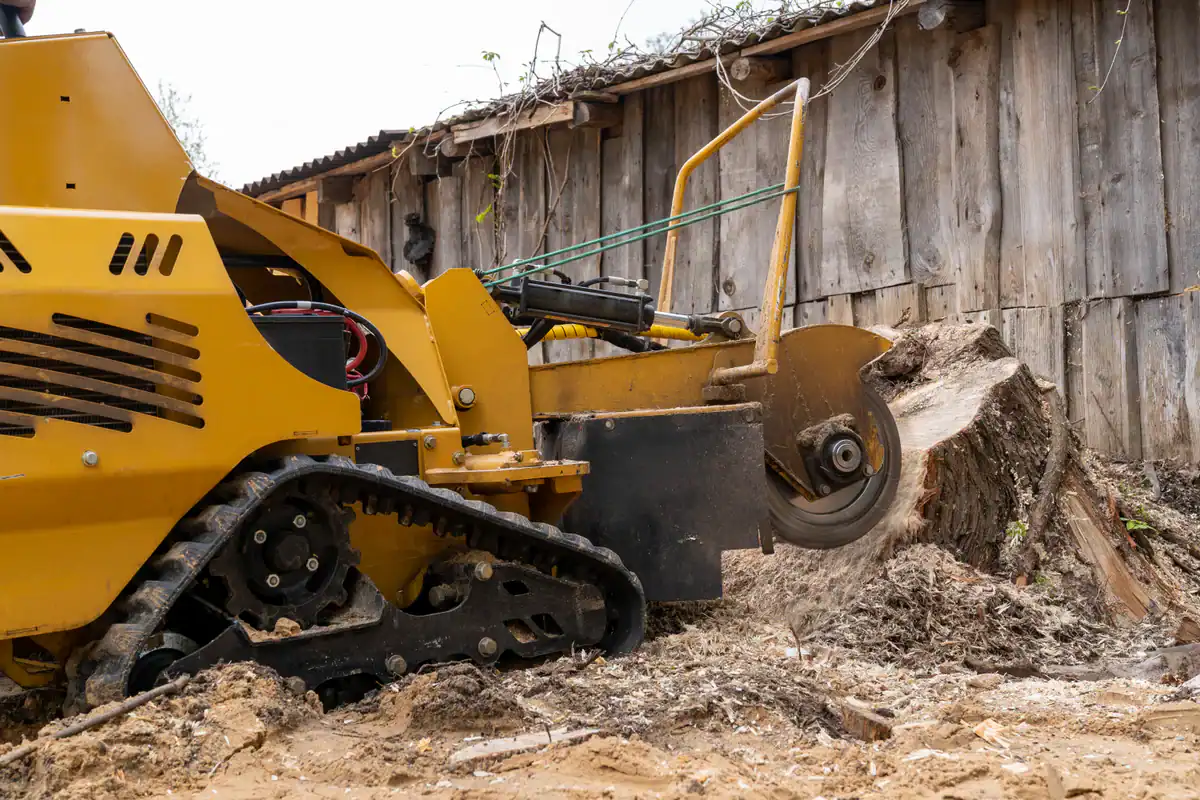
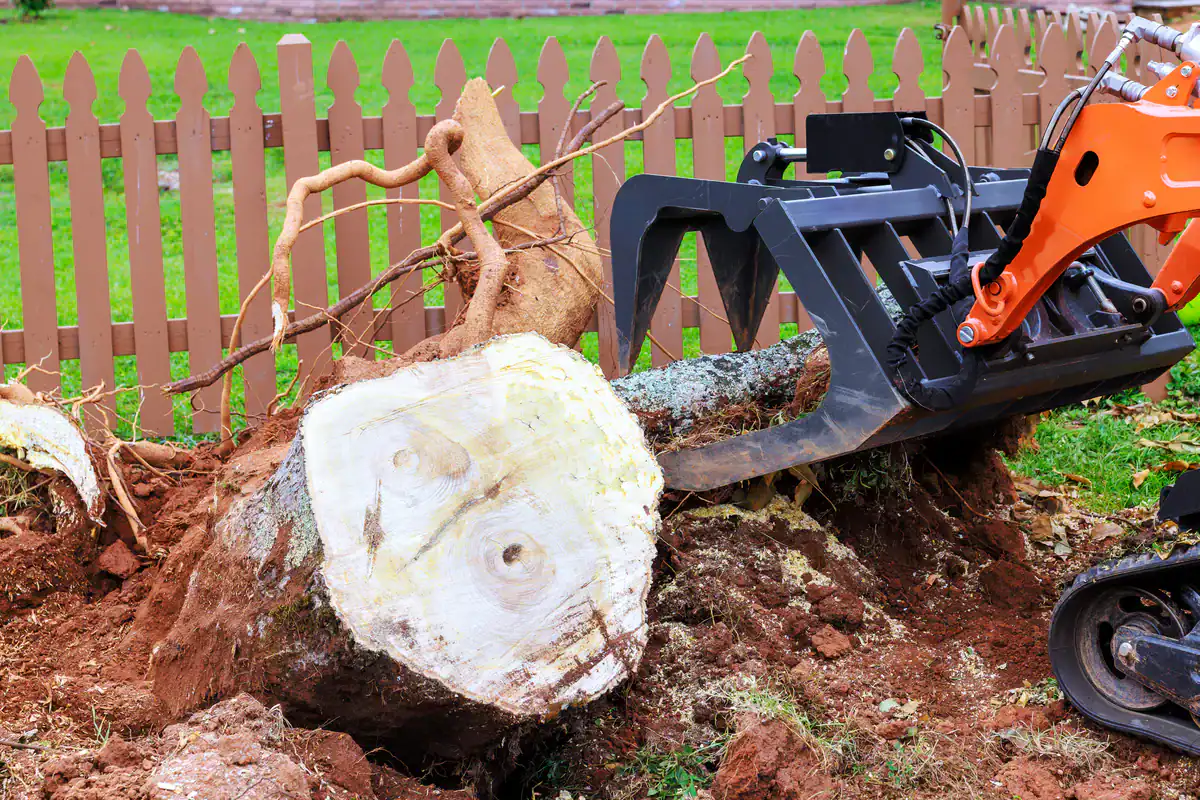
Stump removal is a separate step from tree removal, and it’s worth thinking about before the job starts. When a tree is cut down, the stump and root system remain in the ground unless you specifically request grinding or removal. Stump grinding uses a machine to grind the stump down several inches below ground level, leaving behind wood chips that can be used as mulch or removed along with the rest of the debris.
In Basehor’s newer subdivisions, where properties often have finished lawns, landscaping, and HOA standards to consider, leaving a stump behind can be a practical problem — it’s a mowing obstacle, a tripping hazard, and in some communities, an HOA compliance issue. If you’re in Falcon Lakes or another HOA-governed community, it’s worth checking your association’s standards before deciding whether to grind the stump or leave it. We handle stump grinding as part of the broader job, so it’s easy to address at the same time as the removal rather than scheduling a separate visit later.
Yes, Emerald Ash Borer is an active threat in Leavenworth County and throughout the Kansas City, KS & MO metro. EAB is a destructive invasive beetle that kills ash trees within two to five years of infestation. Once an ash tree is heavily infested, it typically cannot be saved — and dead ash trees become structurally brittle relatively quickly, making them a falling hazard even in calm weather.
If you have an ash tree on your Basehor property that’s showing signs of thinning canopy, D-shaped exit holes in the bark, S-shaped galleries under the bark, or significant dieback from the top down, it’s worth getting a professional assessment soon. Early-stage infestations can sometimes be treated to slow or stop the progression, but a tree that’s already mostly dead needs to come down before it becomes a hazard. Given how many of Basehor’s subdivisions were planted with ash trees during the development boom of the 2000s, this is a more common situation in the area than most homeowners realize. A site visit will tell you exactly where your tree stands and what the right next step is.
Other Services we provide in Basehor