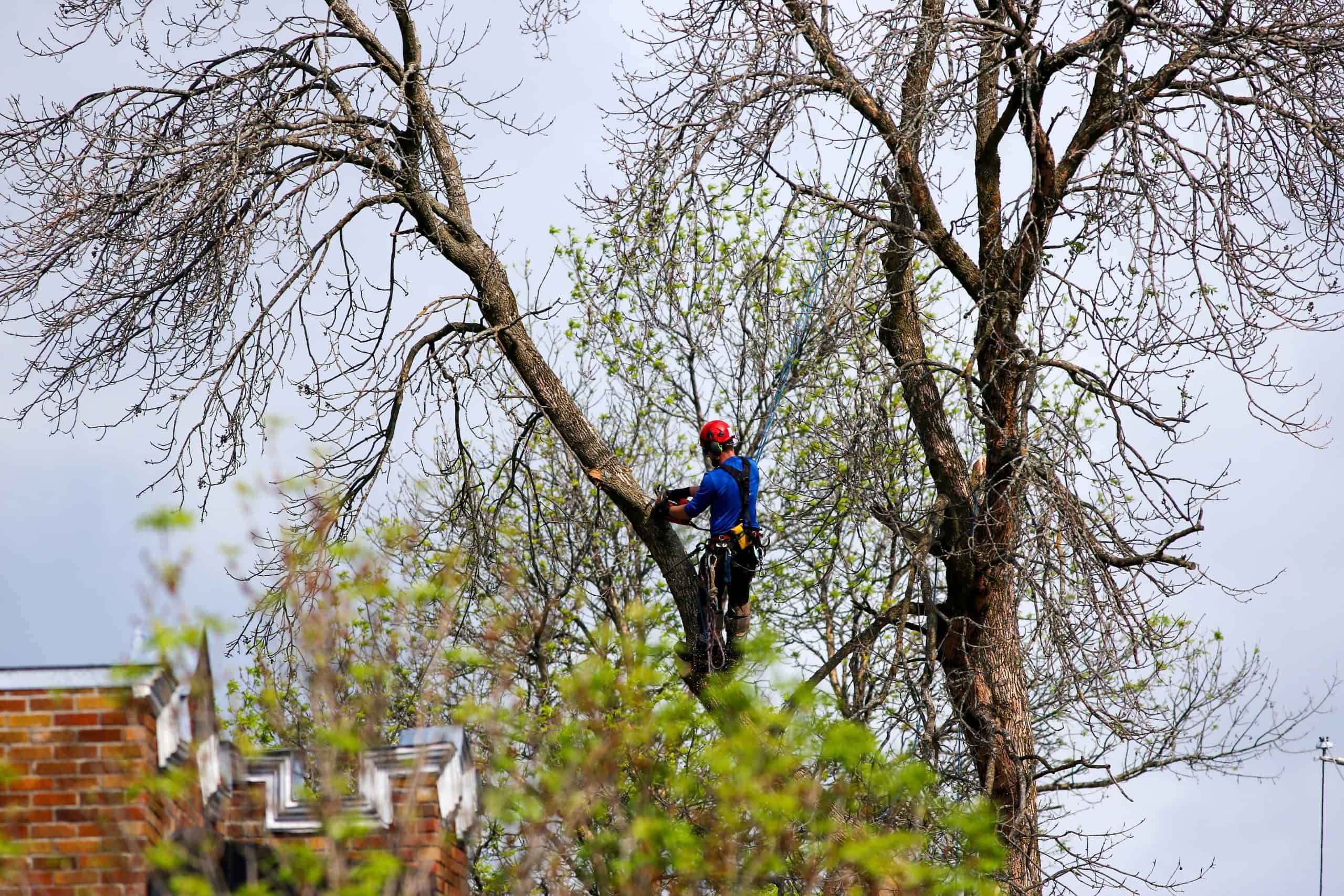
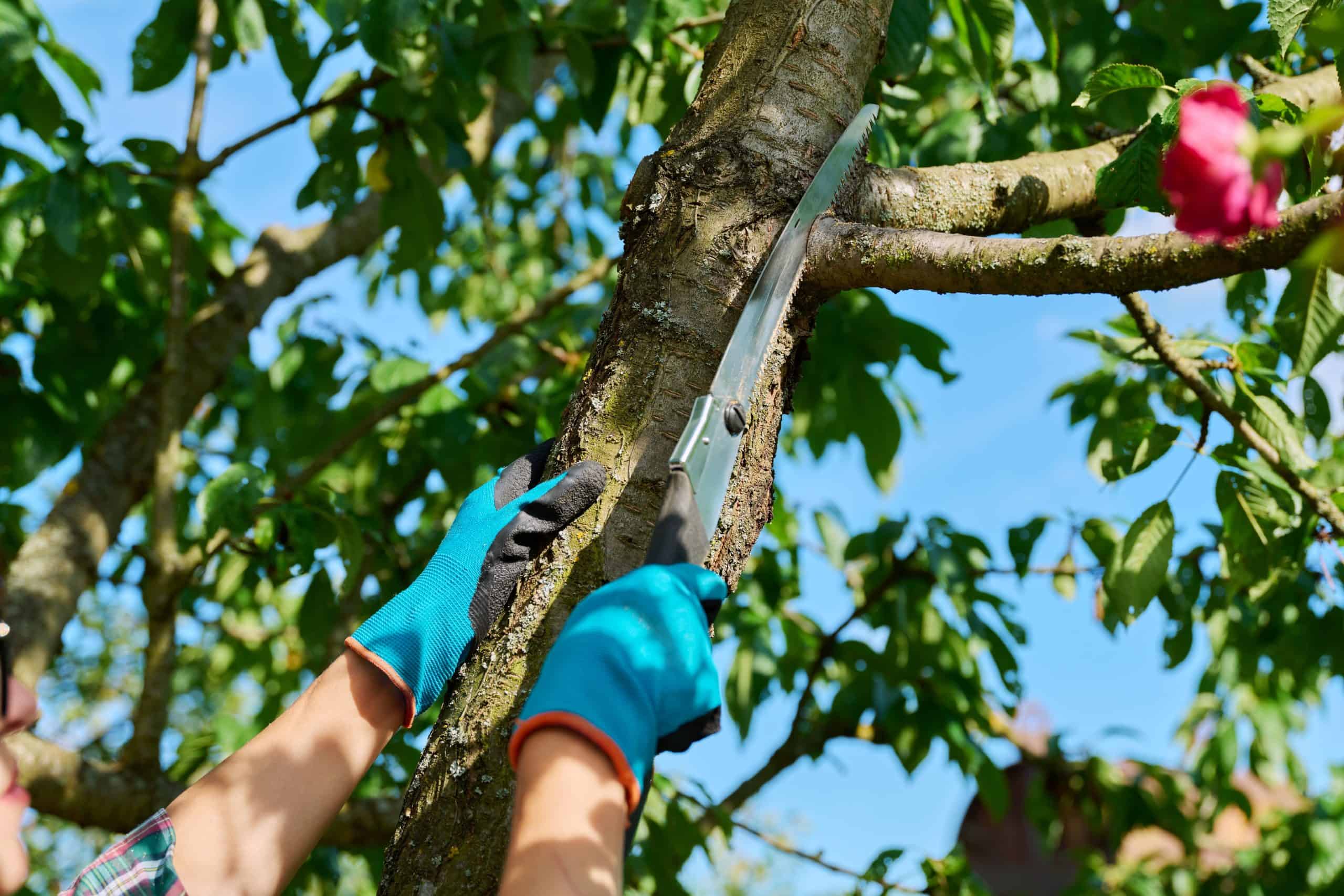
When your trees are trimmed properly, the difference isn’t subtle. Branches that were creeping over your roofline or hanging into your neighbor’s yard are gone. Your home’s exterior — the Tudor Revival details, the roofline, the front facade — is visible again the way it was meant to be. In a National Historic District where every property contributes to the character of the street, that matters more than it would in most neighborhoods.
Westwood Hills is the most densely populated city in the Kansas City, KS & MO metro. On lots this close together, an overgrown canopy isn’t just your problem. Branches that cross property lines, block sightlines, or drop debris onto a neighbor’s driveway are everyday realities here. Canopy raising — lifting the lower crown of a large tree to create clearance above structures, fences, and walkways — is one of the most practical things you can do on a property this size. It opens up the space underneath without removing the tree, and it keeps things civil in a neighborhood where you can practically shake hands with your neighbor from your front porch.
Mature trees also carry real risk when they’re not managed. Dead branches, weak unions, and crowns that have grown unchecked for years are the kind of thing that looks fine until a spring storm comes through. Kansas City, KS & MO’s severe weather season is hard on large, established trees — and the oaks and maples in Westwood Hills have had a century to grow heavy. Getting ahead of that is a lot less expensive than dealing with what happens after.
We’re a family-owned, fully insured tree care company based in Kansas City, KS & MO. We’ve been doing this work for over 10 years across the Kansas City, KS & MO metro, and we already serve Mission — which puts Westwood Hills squarely in our backyard, not a stretch of our service area.
Our crew has safely removed and trimmed more than 1,200 trees across Kansas homes with a 100% safety record. On a street in Westwood Hills, where homes sit just feet apart and the properties on either side of you are historic, that track record isn’t just a number — it’s the reason you don’t have to worry about what happens if something goes wrong. We carry full general liability and workers’ compensation insurance, so you’re covered either way.
Our 4.9-star rating across 40-plus verified reviews reflects the kind of work that earns repeat calls. Reviewers specifically mention that cleanup extended to the neighbor’s property, that the job was done the same day, and that the price was exactly what was quoted. In a community of 175 homes in Westwood Hills where reputation matters, that track record means something.
It starts with a free on-site quote. Someone from our crew comes out, walks the property with you, and takes a look at what you’re working with. For a lot of Westwood Hills homeowners, this is also where they find out about a branch or structural issue they hadn’t noticed — dead wood, a crossing limb, or a section of crown that’s been quietly growing toward the house. The assessment is free, and most quotes are given the same day.
Once you approve the work, we handle everything. For tree trimming in Westwood Hills, that typically means working within tight property lines, being careful around neighboring structures, and managing the canopy in a way that respects the historic character of the streetscape. Canopy raising, tree shaping, and branch trimming are all done with the full picture in mind — not just the tree in isolation, but how it sits on the lot and how it relates to what’s around it.
One thing worth knowing: Westwood Hills city ordinance strictly prohibits outdoor burning of any lawn refuse or debris. That means trimmed branches can’t be left in a pile for you to deal with later. We include full cleanup on every job — everything is hauled away, and the property is left clean. If you want to keep the wood or mulch, just say so. Otherwise, it’s gone.
Timing matters too. Late winter to early spring is the best window for most of the deciduous species common in Westwood Hills — oaks, maples, elms. Trimming during dormancy is less stressful on the tree, reduces the risk of disease entry, and gives you the clearest view of the tree’s structure. We can advise on timing when we come out for the quote.
Ready to get started?
Tree trimming covers a range of work depending on what the tree actually needs. For most Westwood Hills properties, that includes canopy trimming to manage the overall size and shape of the crown, canopy raising to lift the lower limbs and create clearance above driveways, structures, and neighboring property lines, and tree shaping to keep the tree looking proportional to the lot and the home. Overgrown tree trimming — where a tree has been left alone for years and has grown well beyond its original form — is also common in a neighborhood with trees this old.
Dead branch removal is part of the work too, and it’s not just cosmetic. Dead wood is the first thing that comes down in a storm. In a city as dense as Westwood Hills, a falling branch has a lot of places to land that you don’t want it to. Removing it proactively is straightforward; dealing with it after a storm event is not.
Every job includes full cleanup. No debris piles, no wood left on the lawn, no chips in the driveway. This is standard on every job — not an add-on. Given that Westwood Hills ordinance prohibits burning any outdoor lawn refuse, there’s no other acceptable outcome anyway. We also do a walkthrough of the property before we leave, so you can see exactly what was done and ask any questions. Pricing varies based on tree size and the scope of work, and a free quote is always the starting point.
For routine tree trimming and pruning on your own property, you generally don’t need a permit in Westwood Hills. Minor landscaping and maintenance work is typically exempt from the city’s building permit requirements. That said, if you’re looking at removing a large, significant tree — especially one that might affect neighboring structures or a shared boundary — it’s worth a quick call to the City of Westwood Hills, which handles building and inspection services, just to confirm before the work starts.
What Westwood Hills does have on the books is a mandatory removal ordinance for diseased or dead trees. If a tree on your property is dead or visibly diseased and you don’t address it promptly, the city has the authority to remove it and bill you for the cost. Getting a professional assessment before the city flags the issue puts you in control of the timeline and the cost.
For most mature deciduous trees — the oaks, maples, and elms that are common throughout Westwood Hills — a trimming cycle of every three to five years is a reasonable baseline. Younger trees typically benefit from more frequent attention, around every two to three years, while they’re still developing their structure. That said, age and size aren’t the only factors.
A tree that’s grown close to a structure, started dropping branches, or developed visible dead wood may need attention sooner regardless of when it was last trimmed. In Westwood Hills, where the trees have been growing since the 1920s, “every few years” can mean a significant amount of growth between visits. Kansas City, KS & MO’s storm season accelerates that — heavy spring winds and ice events in winter are hard on large, mature crowns. An annual visual check is a good habit even if you’re not scheduling a full trim every year.
Canopy raising is the process of removing the lower branches of a tree to elevate the bottom of the crown. The goal is to create vertical clearance — above a driveway, a walkway, a fence line, a neighboring structure, or just the space beneath the tree itself. It doesn’t reduce the overall size of the tree or change its character; it just lifts the point where the canopy begins.
In Westwood Hills specifically, canopy raising is one of the most practical trimming services available. The city covers just 0.07 square miles and the lots are small — which means large, mature trees often have lower limbs that extend over driveways, hang close to rooflines, or reach into neighboring yards within just a few years of unchecked growth. Raising the canopy creates clearance without removing the tree, preserves the wooded character that makes this neighborhood what it is, and reduces the friction that comes with branches constantly encroaching on tight property lines. If you’re not sure whether your trees are candidates for canopy raising, the on-site assessment will tell you.
The terms get used interchangeably, but they describe slightly different work. Tree trimming is primarily about managing the size, shape, and clearance of a tree — cutting back overgrowth, shaping the canopy, raising the crown, and keeping the tree proportional to its surroundings. It’s largely about how the tree looks and how it interacts with the space around it.
Tree pruning is more targeted toward the health and structure of the tree itself. It involves removing dead, diseased, or crossing branches, improving airflow through the canopy, and addressing structural issues that could become problems down the line — weak branch unions, co-dominant stems, or limbs growing in directions that put them at risk of failure. In practice, most professional tree work involves both. A crew that’s trimming for clearance should also be removing anything dead or structurally compromised while they’re up there. We handle both as part of our standard tree trimming work, so you’re not getting one without the other.
Tree trimming costs vary based on the size of the tree, how many trees you’re having done, how accessible they are, and the specific work involved. Nationally, most homeowners pay somewhere between $300 and $900 per tree, with smaller trees on the lower end and large, mature specimens on the higher end. For a neighborhood like Westwood Hills — where the trees are old, large, and often sitting close to structures — you’re generally looking at the middle to upper end of that range for a significant tree.
The most reliable way to get an accurate number is to have someone come out and look. We offer free on-site quotes, and most are given the same day. There’s no obligation, no pressure, and the price you’re quoted is the price you pay — no runaround. If you’re getting multiple quotes, that’s a reasonable thing to do. Just make sure any company you’re considering is fully insured, because an uninsured crew working on your property in a neighborhood with $600,000 homes creates a liability exposure that no savings on the quote is worth.
In Kansas, the general legal principle is that you have the right to trim branches that cross your property line, up to the property line itself. You can hire a tree service to cut back what’s encroaching on your side — but you’re responsible for the cost, and you can’t cut beyond the line onto your neighbor’s property. If the overhanging branches are causing actual damage, that’s a separate conversation that may involve your neighbor directly or, in some cases, your homeowner’s insurance.
In a city as compact as Westwood Hills, this situation comes up more than it does in lower-density neighborhoods. The lots are small, the trees are large, and the property lines are close. Before you take any action, it’s worth knowing where your property line actually sits — especially in a neighborhood where the original 1922 plat established boundaries that don’t always match what you’d assume from looking at the yard. We can assess what’s on your side, what’s on theirs, and what the cleanest solution looks like — without creating a dispute with a neighbor you’ll be living next to for years.
Other Services we provide in Westwood Hills