Mission Woods was built around its trees. J.C. Nichols didn’t just plant them for looks — they were part of why the land was worth developing in the first place. But the same oaks and maples that made these four streets beautiful in the 1930s are now pushing 80 to 100 years old, and age changes everything about how a tree behaves.
What looks solid from the sidewalk can be hollow at the core, stressed at the roots, or quietly losing the structural integrity that keeps it standing on a calm day. When a hazardous tree gets removed the right way, you stop carrying that risk. You stop watching the canopy every time a storm rolls through. You stop wondering whether your homeowners insurance would actually cover the damage if that limb came down on your neighbor’s fence line — because if the tree was visibly dead or diseased and you knew about it, your insurer may not cover it.
Getting ahead of that is the financially responsible move, not just the cautious one. After the job is done, your property is clean. No wood piles, no debris scattered across the street, no chips left in the yard for you to deal with. Every job we complete ends with full cleanup — and if you want to keep the wood or mulch for personal use, just say so before we start.
We’ve been working in the Kansas City, KS & MO metro for over a decade, with deep roots in northeast Johnson County. That means we’ve spent years learning the tree species, the soil conditions, the storm patterns, and the specific challenges that come with Mission Woods’ four-street layout and the tight-quarters neighborhoods along the State Line Road and Rainbow Boulevard corridor.
We’re a family-owned, Kansas-raised crew — not a franchise, not a call center dispatching whoever’s available. When you call us, you get the same tight-knit team that’s been doing this work for 10-plus years, and we treat every property in Mission Woods like we’re the ones who have to live next door to it afterward.
We’re fully insured — liability and workers’ compensation both. In a neighborhood where a falling limb can reach a $785,000 home on the other side of the fence, that’s not a footnote. It’s the first thing you should ask any tree service to prove before they touch a single branch.
It starts with a free estimate. We come out, look at the tree, and give you a straight answer about what it actually needs. If a strategic trim can solve the problem, we’ll tell you that. If the tree needs to come down, we’ll explain why and walk you through what the job involves. No pressure, no upsell, no invoice padding.
Once you’re ready to move forward, we schedule the work and show up when we say we will. For Mission Woods specifically, we plan the removal around the tight residential conditions that come with four streets and 80 homes in 0.10 square miles. That means thinking carefully about the direction of the fall, the proximity of neighboring structures, whether the canopy overhangs the right-of-way along Shawnee Mission Parkway or Rainbow Boulevard, and how to move equipment without tearing up the property.
We’ve taken down large trees in dense neighborhoods before — customers have specifically called out our ability to remove mature specimens in close quarters without touching what’s next to them. One thing worth knowing before you start: Mission Woods homeowners are responsible for trees whose base sits on their property, even if the canopy extends over a neighbor’s yard. The city handles right-of-way trees on its own schedule, but private trees are yours to manage.
After the work is done, we clean up completely. The property gets left neat and safe — no piles, no debris, no mess for you to deal with later.
Ready to get started?
The trees in Mission Woods aren’t small ornamentals. They’re large, mature specimens — the kind that take two people and a full day to remove safely when they’re positioned near a home, a parked car on a narrow street, or the office buildings along Rainbow Boulevard. We’re set up for exactly this kind of work.
Tree removal, stump grinding, brush removal, and emergency storm response are all part of what we do, and we bring the same fully insured, experienced crew to every job regardless of size. Diseased tree removal is increasingly relevant in Johnson County. Emerald Ash Borer has been documented across the county, and any ash trees in Mission Woods — which at this point would be decades old — should be assessed sooner rather than later.
A dead or dying ash that goes unaddressed doesn’t just create a hazard on your property. In a neighborhood this compact, it becomes a hazard for everyone on the street. If a storm has already done damage, we respond quickly. We’ve deployed emergency crews across multiple states for large-scale storm recovery events, so a post-storm call in Mission Woods is well within our range. We’ll assess the damage, remove what needs to go, and leave the property safe — whether it’s a single downed limb or a full tree that came down in the night.
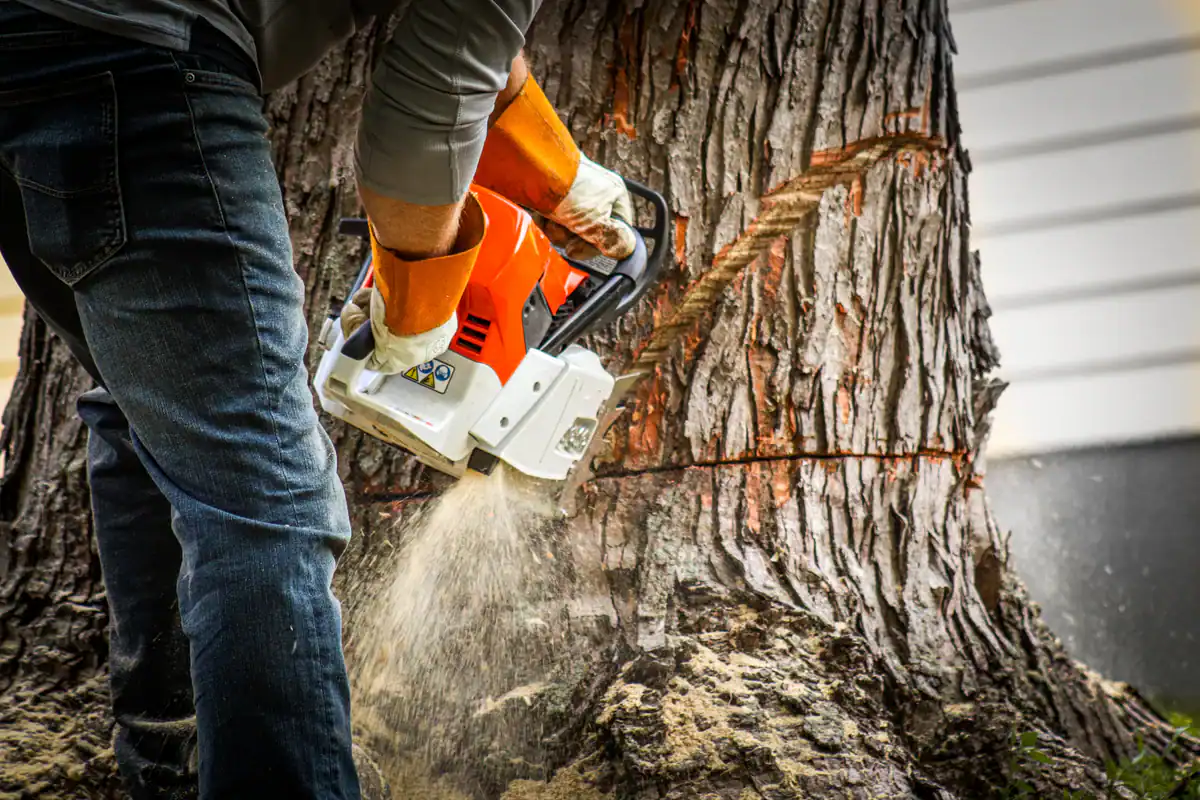
The City of Mission Woods is clear on this: if the base of the tree is on your property, the maintenance and removal are your responsibility — even if the canopy extends over a neighbor’s yard or shades the street. The city does handle trees in the public right-of-way on its own schedule, trimming and removing dead or dying trees as needed. But anything rooted on your lot is yours to manage.
This matters more than most homeowners realize. If a tree on your property falls and damages a neighbor’s home or vehicle, and it can be shown that the tree was visibly dead or diseased and you were aware of it, your homeowners insurance may deny the claim based on negligence. That’s a real exposure in Mission Woods, where homes are as close together as they are, and it’s one of the strongest reasons not to wait on a tree you’ve already been watching.
Not every tree that looks rough needs to come down — and we’ll tell you that honestly. The signs that usually point toward removal are: large dead branches that can’t be addressed with a trim, significant decay or hollow sections in the trunk, major root damage, a noticeable lean that wasn’t there before, or a tree that’s been heavily damaged by a storm and has lost more than about a quarter of its canopy structure.
For Mission Woods specifically, the age of the tree matters a lot. The heritage canopy here dates back to the J.C. Nichols development era of the 1930s, which means many of these trees are pushing 80 to 100 years old. At that age, oaks, maples, and elms can carry internal decay that isn’t visible from the outside. A free on-site assessment is the only way to know for certain. We’ll give you a straight answer — and if a trim can solve the problem, that’s what we’ll recommend.
Mission Woods uses an online permit system through GovBuilt, and certain property modifications do require permits before work begins. For straightforward tree removal on private property, there’s no universal permit requirement in the city code as currently published — but the answer can depend on the specific situation, particularly if the removal significantly affects the streetscape of one of the city’s four tree-lined streets.
Mission Woods also has an Architectural Review Board with authority over changes to property appearance, including landscaping. If you’re removing a large tree that’s visible from the street and plan to leave the space unplanted, it’s worth confirming whether ARB notification applies to your situation. The city contracts with Westwood for public works and building codes oversight, so that’s the right contact point for permit questions. We’re familiar with how these processes work in northeast Johnson County and can help you understand what steps may be needed before we start.
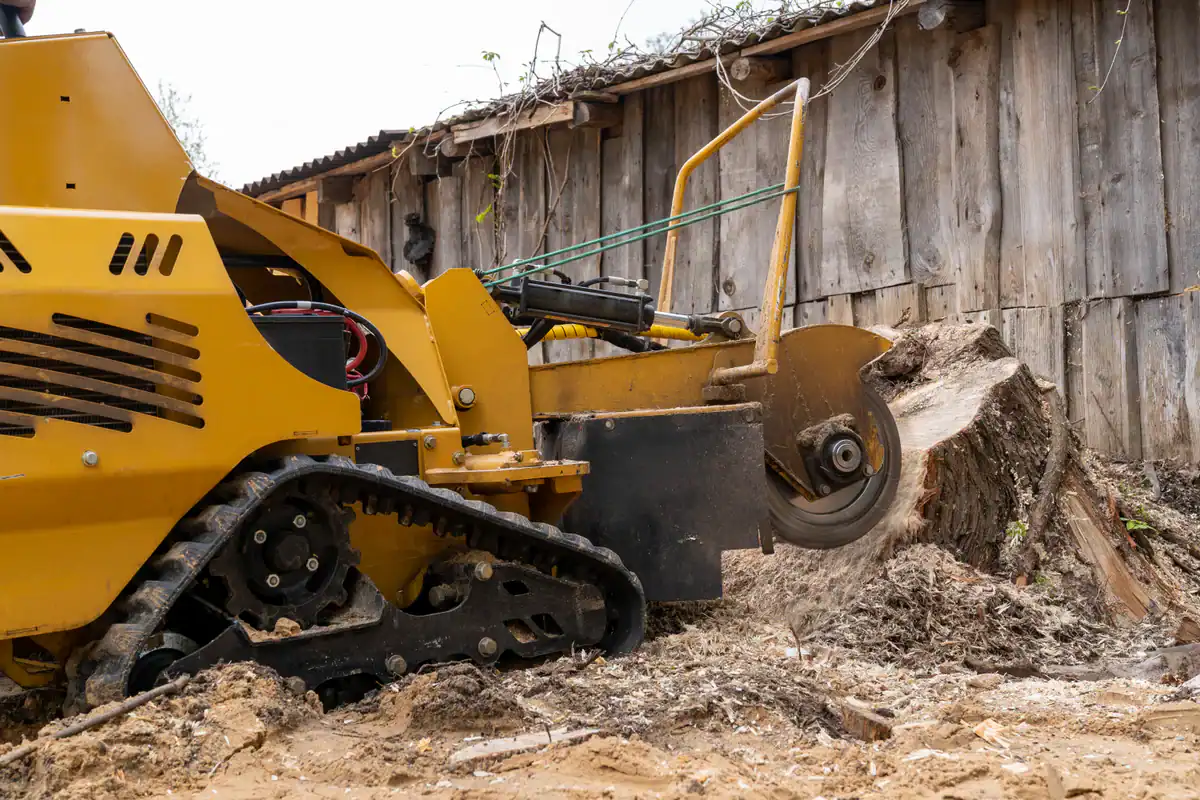
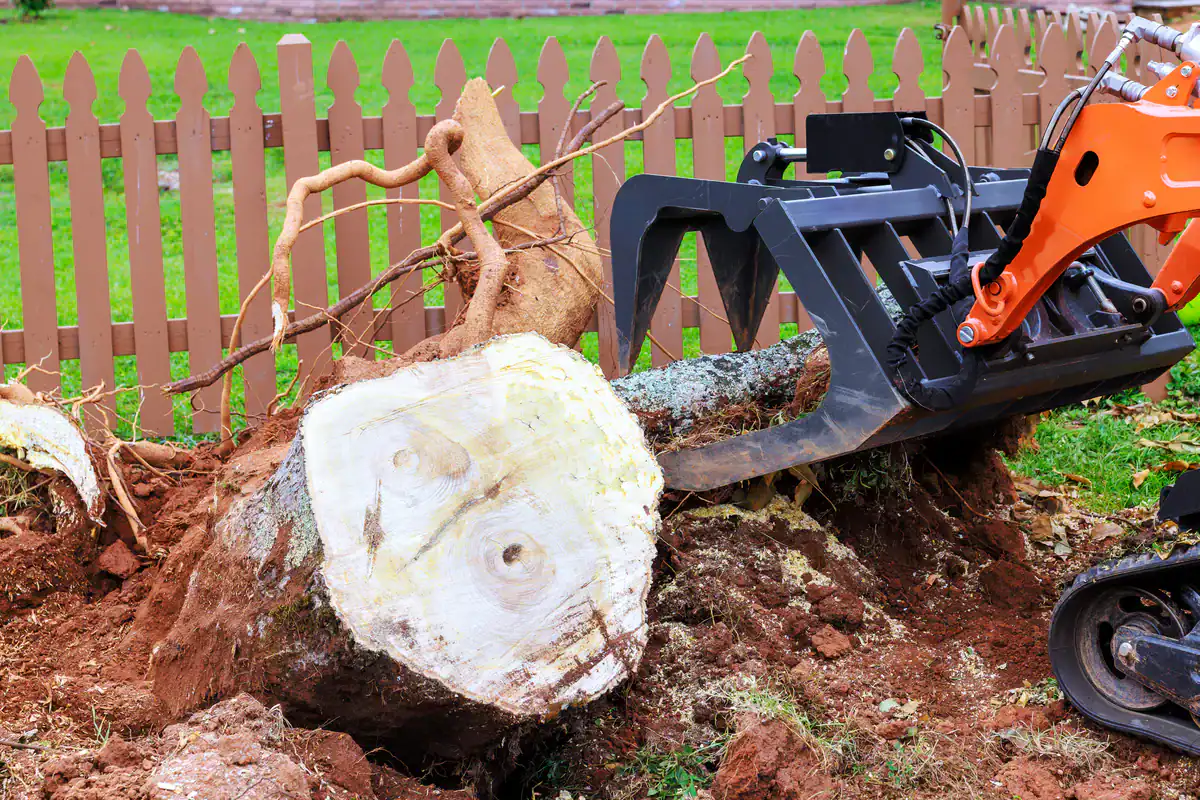
Stump removal is a separate step from tree removal, and it’s one worth thinking through before the job starts rather than after. Once a tree comes down, the stump can be left in place, ground down below the surface, or fully extracted depending on what you want to do with the space. Stump grinding is the most common approach — it takes the stump down several inches below grade, which allows the area to be replanted or covered with sod without a visible obstruction.
In a neighborhood like Mission Woods, where curb appeal is a community value and the Architectural Review Board oversees property appearance, leaving a large stump in a visible front-yard location isn’t always a practical option. It’s also worth noting that a decaying stump can attract insects, including some of the same beetle species that contribute to Oak Wilt transmission in the Kansas City, KS & MO area. Dealing with the stump at the same time as the removal is usually the cleaner, more cost-effective approach — and we’ll walk you through the options during your estimate.
Fast. Johnson County averages 40 to 60 thunderstorm days per year, and when a storm hits a neighborhood like Mission Woods — four streets, 80 homes, trees overhanging the right-of-way along Shawnee Mission Parkway and Rainbow Boulevard — the response window matters. A downed limb on a narrow street or a tree leaning toward a neighbor’s home after an overnight storm isn’t something you want sitting there for days.
We’ve deployed emergency response crews not just in Kansas and Missouri but across multiple states for large-scale storm recovery events. When you call after a storm, we assess the damage, remove what needs to go, and leave the property safe. Multiple customers have confirmed same-day or next-day response for both estimates and completed work in Mission Woods and the surrounding area.
Yes, and sooner is better than later on this one. Emerald Ash Borer has been documented across Johnson County, and ash trees in this part of the metro are at serious risk. In Mission Woods, where the tree canopy dates to the 1930s development era, any ash trees on the property would be among the oldest and largest in the neighborhood — which also makes them some of the most structurally significant to remove safely once they’ve died.
The challenge with EAB is that the damage often progresses internally before the outward signs become obvious. By the time a tree stops leafing out in spring or shows significant canopy dieback, the structural integrity may already be compromised. A dead ash tree doesn’t give you much warning before it fails, and in a neighborhood where homes, parked cars, and neighboring properties are all within range, a failing ash becomes a hazardous tree removal situation quickly. If you have ash trees on your property and haven’t had them assessed recently, it’s worth getting an honest look before the next storm season.
Other Services we provide in Mission Woods