The moment a tree comes down safely and your yard is cleaned up, the worry shifts. That leaning oak near the garage, the ash tree that stopped leafing out two summers ago, the silver maple roots creeping toward your foundation — the risk is gone. That’s what we actually deliver: not just a stump where a tree used to be, but real peace of mind.
For Lenexa homeowners, that risk is concrete. Johnson County sits under an active Emerald Ash Borer quarantine, and the City of Lenexa’s own records show EAB has already killed 10% of the city’s ash trees. A dead ash doesn’t just look bad — within a year or two of dying, it becomes brittle and unpredictable. It can drop branches on a calm afternoon just as easily as during a storm.
Then there’s the soil. Lenexa sits on the Wymore-Ladoga clay formation — 60 to 80% clay content that expands when wet and contracts when dry. Trees with aggressive root systems, silver maples and Bradford pears especially, pull moisture out of that clay during dry stretches and cause the soil beneath your foundation to settle unevenly. You won’t always see it coming until it shows up as a crack in the wall or a door that won’t close right.
Removing the right tree at the right time is a fraction of what foundation repair costs later. We’ve seen this pattern repeat across Lenexa’s established neighborhoods, and it’s preventable.
We’ve been serving the Kansas City, KS & MO metro for over a decade — including Lenexa and the surrounding Johnson County communities. Our crew is Kansas-raised and works in the same neighborhoods where we live. That’s not a marketing line. It just means when a job goes sideways, there’s no one to pass the blame to. We’re the ones who have to face it.
Our work covers everything from a single dead ash in a Canyon Creek backyard to full storm cleanup after one of Johnson County’s spring supercells rolls through. Every job includes full cleanup — no wood piles, no chip piles, no debris left on your lawn. If you want to keep the mulch or firewood, say so upfront and we’ll set it aside. If not, it leaves with us.
We’re fully insured, including both liability and workers’ compensation. In a city where the median home value is pushing $440,000, that’s not a small detail. If something goes wrong on the job — property damage or a crew injury — you’re covered on both sides.
It starts with a free on-site estimate. We come out, look at the tree, and give you a straight answer — what it needs, what it’ll take, and what it’ll cost. If a trim can solve the problem instead of a full removal, we’ll tell you that too. No upsell, no pressure to go bigger than necessary.
Once you’re ready to move forward, our crew handles the full removal from start to finish. For large trees in established Lenexa neighborhoods — the kind close to rooflines, fences, or neighboring lots in places like Falcon Valley or the Canyon Creek communities — we work in sections, carefully controlling where each piece falls. That matters in dense residential areas where there’s no open field to drop a 60-foot silver maple all at once.
One thing worth knowing for Lenexa specifically: the city has active tree regulations, including clearance requirements for trees near roadways, and some removal scenarios may require a permit depending on the location and scope of the work. We flag that before you’re caught off guard. After the tree is down, everything gets cleaned up — wood, brush, chips, and debris — before we leave your property.
Ready to get started?
Tree removal in Lenexa isn’t one-size-fits-all, and our service reflects that. Dead tree removal, diseased tree removal, hazardous tree removal, large tree removal — each comes with its own set of conditions depending on where the tree is, what’s around it, and how far gone it already is.
Dead and diseased trees are a particular issue in Lenexa right now. The EAB quarantine means ash trees across Johnson County have been dying off for years, and many homeowners still have standing dead ash on their properties — some aware, some not. Dead ash trees lose structural integrity fast. The bark starts to separate, the wood becomes brittle, and what looked stable last season can fail without warning. The quarantine also regulates how ash wood gets moved and disposed of, so working with a crew that understands that matters.
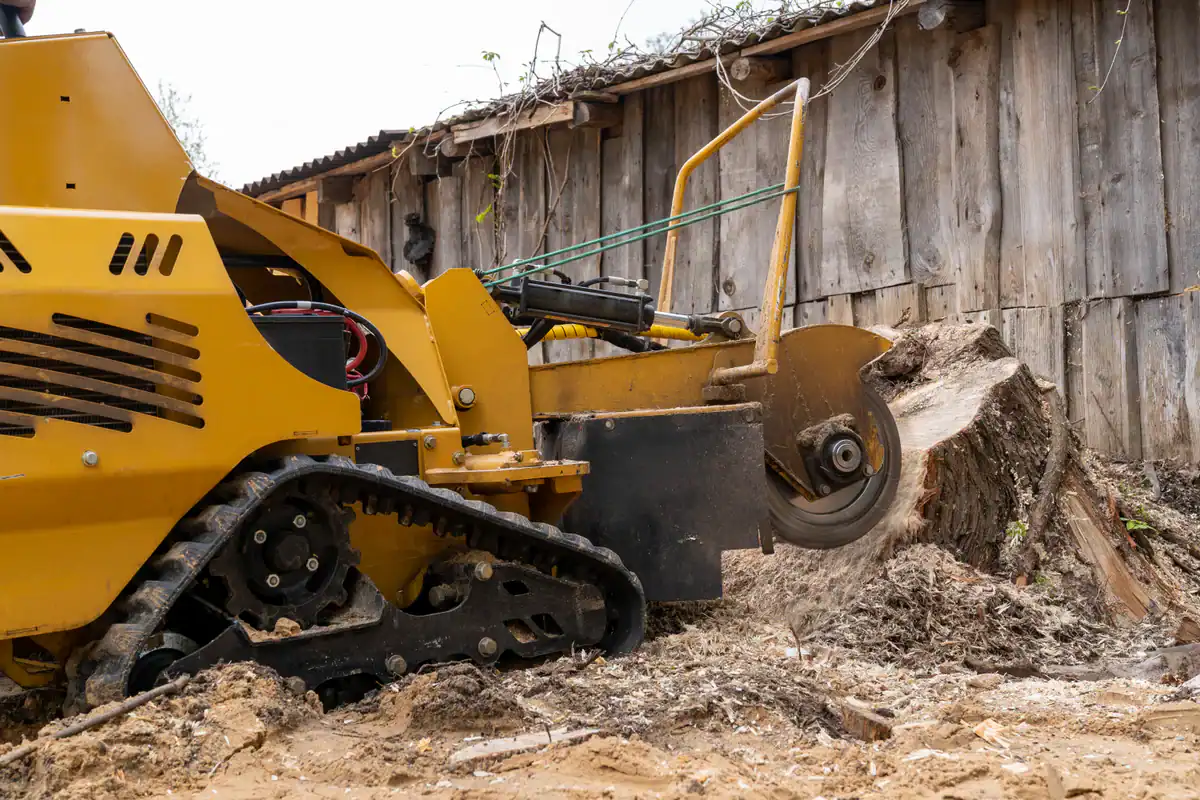
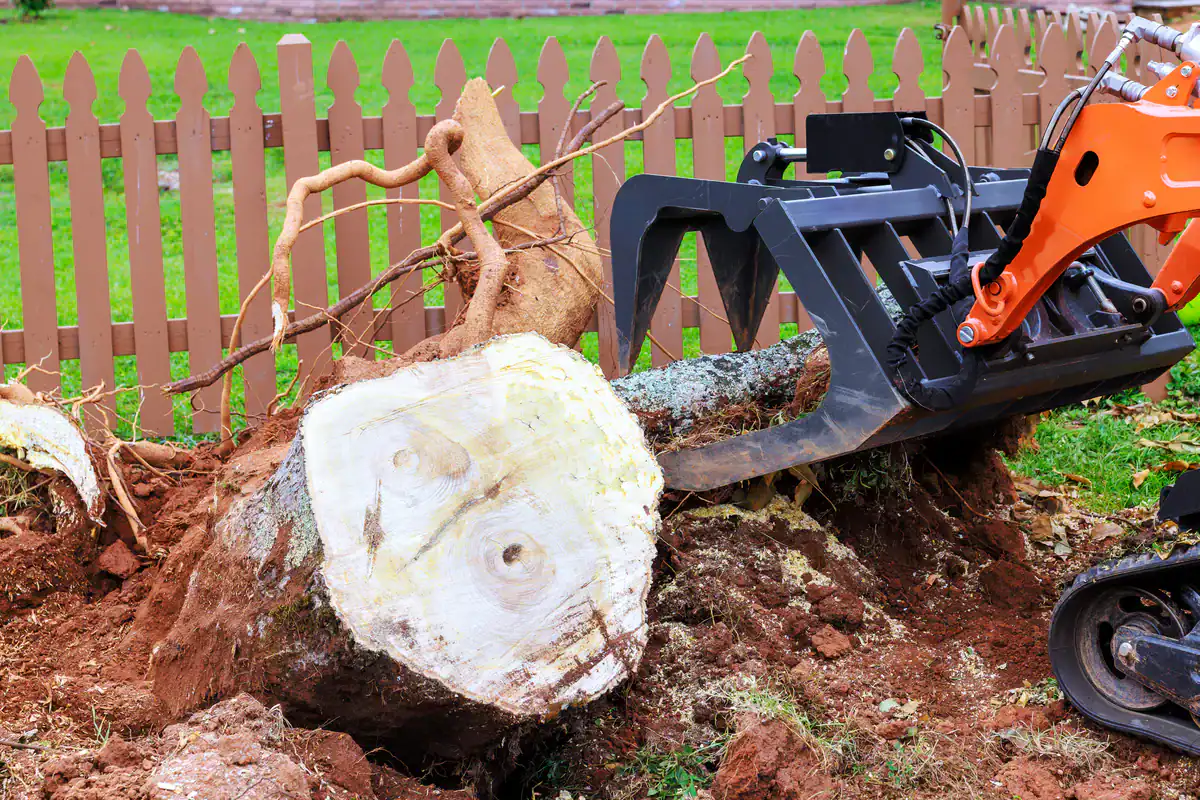
For larger removals — mature oaks, overgrown silver maples, cottonwoods near the Turkey Creek drainage corridor — the job requires more planning and precision. We offer stump grinding after removal to bring the area back to usable condition. Brush removal is included as part of the full cleanup on every job.
If the storm already happened and you’re dealing with a downed tree across your driveway or a limb through a fence, we offer emergency response. We’ve handled large-scale storm recovery work across multiple states, so a bad Johnson County supercell is well within our range.
Lenexa has active tree regulations, and depending on your situation, a permit may be required before removal begins. The city’s code includes clearance requirements for trees near roadways — specifically, trees and shrubs near streets need to maintain at least 12 to 15 feet of clearance from the curb. There’s also a permit process that applies to certain tree cutting scenarios, particularly for trees in or near public rights-of-way.
For trees on private residential property that aren’t near a street or utility corridor, the requirements may be more straightforward — but it’s worth confirming before work starts. Getting caught mid-job without the right paperwork creates headaches that are easy to avoid. We’re familiar with Lenexa’s code and can help you figure out what applies to your specific situation before the first cut is made. When in doubt, a quick check with the City of Lenexa’s community standards or permit office will give you a definitive answer for your address.
This is one of the most common questions, and the honest answer is: it depends on what’s actually going on with the tree. Not every problem tree needs to come down. If less than about 25% of the branches are damaged or dead, many trees can recover with strategic pruning. But there are situations where removal is the right call — when the trunk is structurally compromised, when the root system is causing foundation or hardscape damage, or when the tree is dead and becoming a fall risk.
In Lenexa, a few specific scenarios come up regularly. Ash trees affected by Emerald Ash Borer are typically past the point of saving once the infestation is advanced — treatment works best as prevention, not after the tree has already died. Silver maples and Bradford pears in older neighborhoods often develop structural weaknesses that make them high-risk regardless of how they look from the street. The best way to get a straight answer is an on-site assessment. We’ll tell you what the tree actually needs — not what generates the biggest invoice.
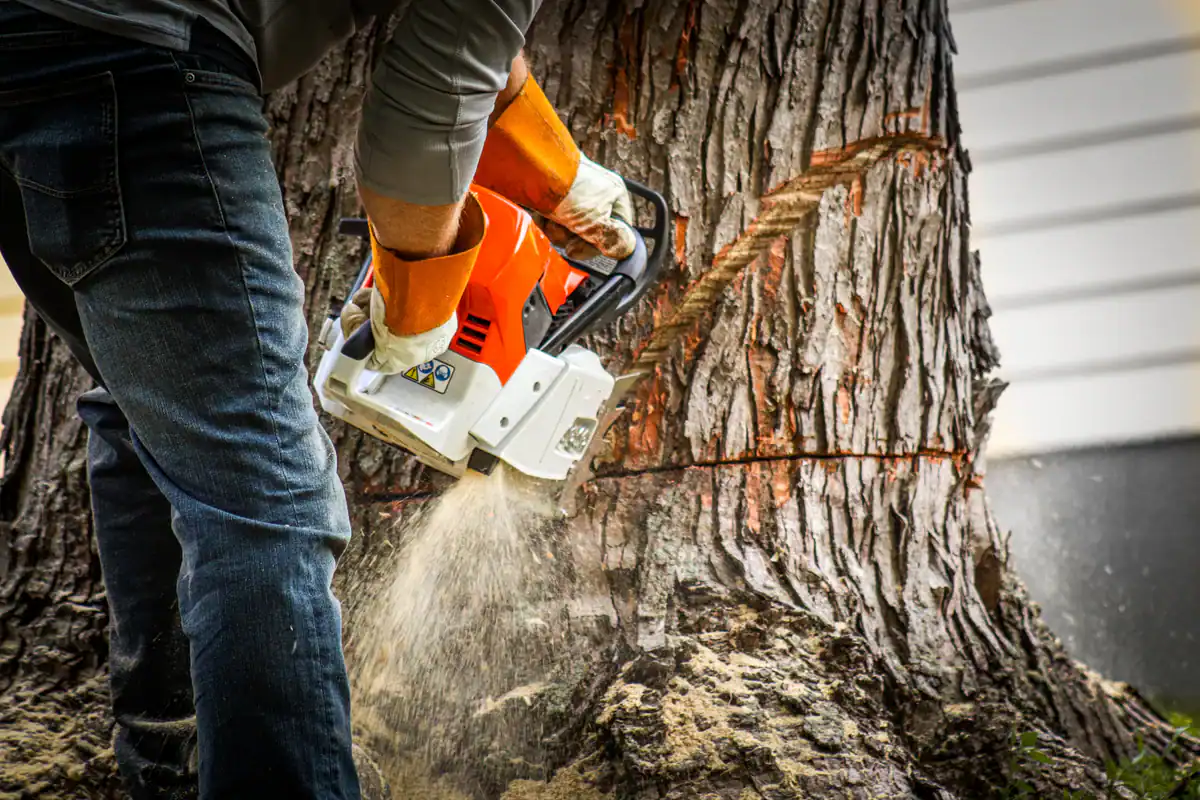
Done right, tree removal causes minimal disruption to the surrounding area. We work in sections on larger trees, controlling exactly where each piece lands rather than dropping the whole thing at once. This is especially important in Lenexa’s established residential subdivisions — places like Falcon Valley, Canyon Creek, and the older neighborhoods near Old Town — where lots back up to neighbor properties, HOA-maintained common areas, or trail corridors.
After the tree is down, full cleanup is included on every job. That means wood, branches, brush, and chip debris all leave with us. If you want to keep the firewood or mulch, just say so before the job starts and we’ll set it aside for you. Stump grinding is available separately and brings the remaining stump down below grade, so the area can eventually be replanted, sodded over, or just left clean. The goal is that your yard looks right when we leave — not like a job site.
If your ash tree has thinning or dying branches starting at the top of the canopy, S-shaped feeding galleries under the bark, or D-shaped exit holes in the trunk, Emerald Ash Borer is very likely the cause. Johnson County, including Lenexa, is under an active EAB quarantine, and the City of Lenexa has documented that the beetle has already killed 10% of the city’s ash trees. The quarantine also regulates how ash wood can be moved after removal — logs, chips, and green lumber from ash trees are restricted to prevent spreading the infestation to unaffected areas.
Once an ash tree is dead, the clock starts moving quickly. Dead ash trees lose structural integrity faster than most other species — the bark separates, the wood becomes brittle, and the tree can drop large branches or fail entirely with little warning. If your ash stopped leafing out last spring or the canopy is noticeably thinner than it used to be, it’s worth getting eyes on it sooner rather than later. Removal while the tree is still standing is significantly safer and less complicated than dealing with one that’s already partially failed.
Tree removal costs vary based on the size of the tree, where it’s located on the property, and what’s around it. A small tree in an open yard is a very different job from a large silver maple that’s grown close to a roofline or a fence shared with a neighbor. Nationally, most tree removals fall somewhere between $750 and $1,200 on average, with larger or more complex jobs running higher depending on the specifics.
In the Kansas City, KS & MO metro, most removals tend to run somewhere in the $300 to $3,500 range depending on those same factors. Lenexa’s housing stock — particularly the mature trees in older neighborhoods like Old Town and the established subdivisions built in the 1970s through 1990s — often involves larger, more established trees that have been growing for decades. Those jobs require more planning and more precision, which is reflected in the cost. The best way to get an accurate number for your specific tree is a free on-site estimate. We don’t publish a price list because no two jobs are the same — but the estimate you get will be honest and straightforward, with no surprise charges after the fact.
It depends on the circumstances, and the details matter more than most people expect. If a healthy tree falls due to a storm — wind, ice, lightning — your homeowners insurance will typically cover the damage it caused to a structure, like a roof or fence. Coverage for the removal itself is often limited, usually somewhere in the $500 to $1,000 range, and only when the tree has actually damaged a covered structure. If it falls in your yard without hitting anything, most policies won’t cover the removal cost at all.
Where it gets more complicated is when the tree was already dead or visibly diseased before it fell. Insurance companies can — and do — deny claims when they can show the homeowner knew or should have known the tree was a risk and didn’t address it. That’s not a rare scenario in Lenexa right now, given how many ash trees have been dying from EAB over the past several years. A dead ash that finally comes down in a spring storm is a very different insurance conversation than a healthy tree that failed in an unexpected weather event. Johnson County gets its share of severe weather — the area has documented wind events with gusts exceeding 80 mph — and a dead or structurally compromised tree doesn’t need that kind of storm to fail. Getting a hazardous tree removed proactively is almost always less expensive than the combination of removal plus uninsured property damage.
Other Services we provide in Lenexa