A tree that looks fine in April can come down in a May storm without a single warning sign. In Blue Springs, that’s not hypothetical — severe thunderstorms along the I-70 corridor have produced 70 mph wind gusts and confirmed tornado activity with documented tree damage in this area. When a large, aging tree is already weakened from years of Jackson County’s clay soil stress and accumulated storm seasons, it doesn’t need a catastrophic event to fail. It just needs the wrong night.
Getting ahead of that is what tree removal actually does for you. It removes the financial exposure. A dead or visibly diseased tree that falls and damages your home, your fence, or your neighbor’s property may not be covered by your homeowners insurance if negligence can be shown — meaning the cost lands on you personally. Proactive removal is cheaper than that conversation.
For Blue Springs homeowners specifically, there’s another layer. The subdivisions off Adams Dairy Parkway, the neighborhoods near Fleming Park, the streets that went up in the late 1980s and early 1990s — those trees are now at the age where internal decay, root compromise from decades in heavy clay soil, and accumulated storm damage converge. You may not be able to see what’s happening inside the trunk. That’s the part that matters most.
We’ve been working the Kansas City, KS & MO metro for over a decade, including Jackson County — the clay soil, the storm patterns, the mature residential tree canopy that defines neighborhoods like those near Blue Springs Lake and the communities along Adams Dairy Parkway. This isn’t a franchise operation dispatching strangers. We’re a family-owned crew that has handled everything from routine removals to multi-state storm recovery deployments across Kansas, Missouri, and beyond.
What that experience actually means for you: we’ve seen the tree species common to Blue Springs yards, we know what decades of KC clay soil does to root systems, and we’ve removed large trees in tight residential neighborhoods without damaging adjacent fences, driveways, or neighboring properties. That track record is documented in reviews from real customers — not marketing copy.
We carry full insurance, including both liability coverage and workers’ compensation. That matters because if an uninsured crew member gets hurt on your property, you could be personally on the hook. We cover that risk so you don’t have to.
It starts with a free estimate. We come out, look at the tree, look at what’s around it — your fence, your garage, your neighbor’s yard — and give you a straight answer on what the job involves and what it costs. If a strategic trim can solve the problem instead of a full removal, we’ll tell you that too. No upsell.
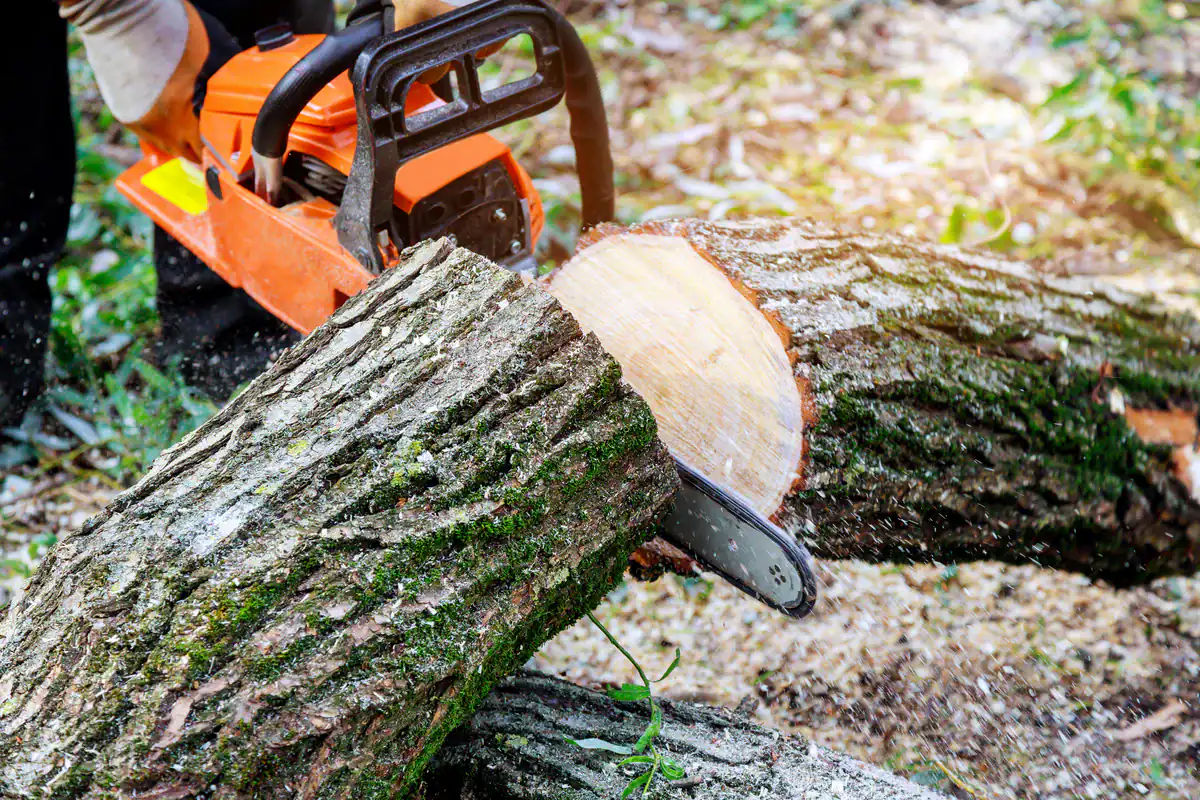
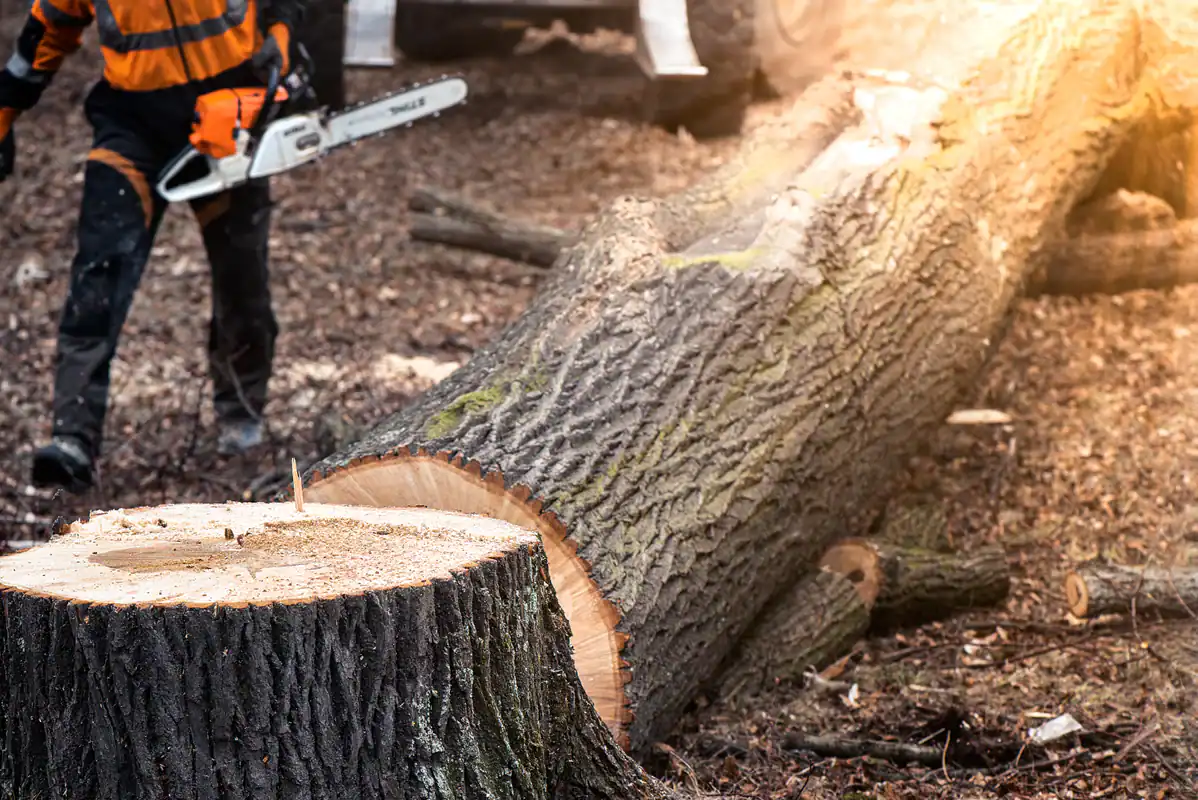
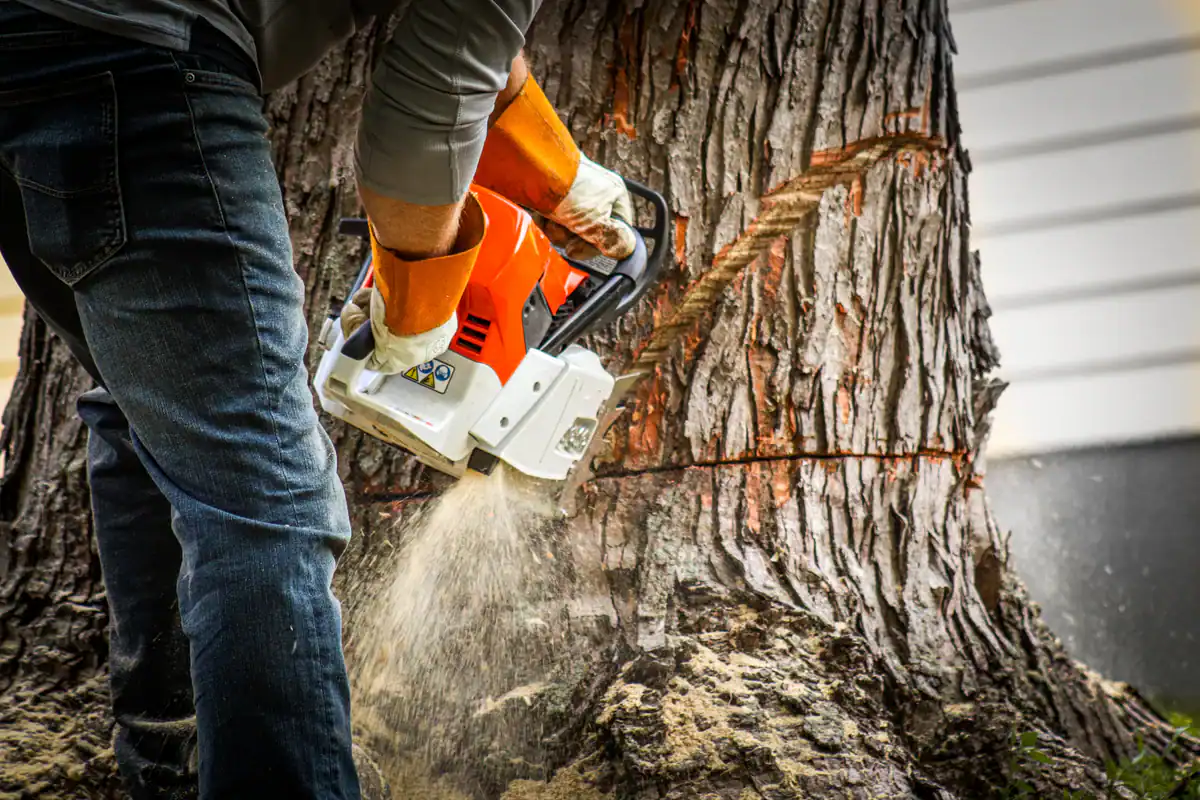
Once you’re ready to move forward, our crew shows up and handles the full job. That means cutting the tree down in sections when needed, managing the fall path carefully in tight spaces, and removing the trunk and debris from your property. In Blue Springs’s established neighborhoods, where homes sit close together and lots aren’t always large, that kind of controlled, methodical work matters. We’ve done this in dense residential areas before, and the reviews from Jackson County homeowners confirm it.
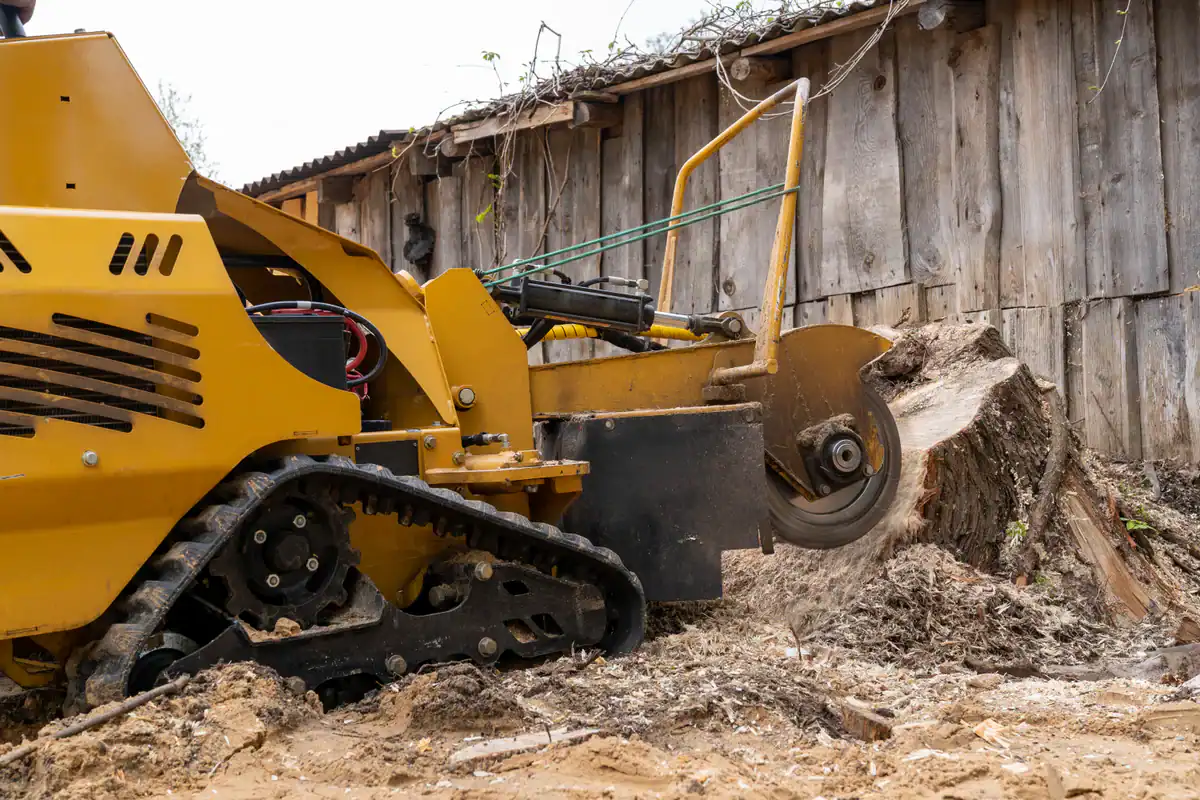
When the job is done, your yard is clean. Full cleanup is included on every removal — no wood piles left behind, no chip mounds sitting in your lawn. If you want to keep the wood or mulch for personal use, just say so before the job starts and we’ll set it aside. Stump grinding is available if you want the area fully restored. One call, one crew, complete job.
One thing worth knowing for Blue Springs specifically: Blue Springs’s municipal code requires that tree limbs overhanging public sidewalks and streets be trimmed to no less than eight feet above those surfaces. If your tree has already crossed that line, you’re not just dealing with a safety issue — you’re dealing with a code compliance issue. That’s worth factoring into the timing of your call.
Ready to get started?
Tree removal in Blue Springs isn’t a one-size situation. A large silver maple that went in during a 1990s subdivision build-out is a different job than a storm-damaged oak near a property line, which is different again from a diseased ash tree showing signs of Emerald Ash Borer — a confirmed threat to Kansas City, KS & MO-area trees. We handle all of it: dead tree removal, diseased tree removal, hazardous tree removal, large tree removal, and full-service tree cutting for residential and commercial properties throughout the Blue Springs area.
Every removal includes complete cleanup. That’s not a bonus — it’s standard. Blue Springs homeowners in HOA communities like Adams Pointe Village and Vespers, or in neighborhoods where curb appearance matters to the block, don’t want to be left managing debris after a crew leaves. You won’t be. The property gets cleaned before we go home.
For properties near the I-70 corridor or in neighborhoods that have taken repeated hits from Jackson County’s spring storm seasons, hazardous tree removal is often time-sensitive. A tree that’s already been compromised by wind, ice loading, or root stress from years in heavy clay soil isn’t going to get more stable on its own. We respond quickly — estimates within 24 hours in most cases, with work often completed the following day. When a tree is actively threatening your home or your neighbor’s property, that response time is the difference between a managed removal and an emergency situation.
For standard residential tree removal on private property in Blue Springs, there’s no permit requirement that applies to most homeowners. What Blue Springs does regulate is tree limbs that overhang public sidewalks and streets — the city’s municipal code requires those limbs be trimmed to no less than eight feet above those surfaces. If your tree has crossed into the public right-of-way, that’s a compliance issue on top of a safety issue, and it’s worth addressing sooner rather than later.
The one situation where permits come into play is park property. Cutting trees in Blue Springs city parks requires written permission from the Director of Parks and Recreation — but that applies to city-owned land, not your residential lot. If you’re unsure whether a tree on your property line touches any public right-of-way, a quick on-site estimate will clarify that before any work begins. We’ll walk through what applies to your specific situation.
This is one of the most common questions homeowners ask, and the honest answer is: it depends on what’s actually going on with the tree, and you usually can’t tell from the outside alone. A tree with dead branches, visible trunk decay, significant lean, or root damage from years in Jackson County’s heavy clay soil may look manageable from the yard but have serious structural problems underneath. On the other hand, if less than about 25% of the tree’s branch structure is damaged, it may recover with proper pruning.
The signs that typically point toward removal rather than trimming include: a hollow or significantly decayed trunk, major root damage or heaving soil around the base, a tree that’s leaning toward a structure after a storm, or a tree that’s been confirmed as diseased — particularly ash trees showing signs of Emerald Ash Borer, which is a documented threat in the Kansas City, KS & MO metro. We’ll give you a straight assessment on-site. If trimming solves it, that’s what we’ll tell you. We’re not going to push a full removal job when it isn’t necessary.
It depends heavily on the circumstances, and the answer isn’t always what homeowners expect. If a healthy tree falls during a storm and damages your home or another covered structure, your homeowners insurance will typically cover some portion of the removal cost — often in the range of $500 to $1,000 for debris removal, with the structural damage covered separately under your dwelling coverage. But if the tree just falls in your yard without hitting anything, most policies won’t cover the removal at all.
The more important issue for Blue Springs homeowners is the negligence angle. If a tree was visibly dead, diseased, or structurally compromised — and your insurer can show you knew about it and didn’t act — they may deny the claim entirely, even if the tree caused real damage. That same negligence argument applies if a tree from your property falls on your neighbor’s fence or car. Jackson County’s spring storm seasons, combined with the mature, aging tree canopy in Blue Springs’s established subdivisions, make this a real and recurring scenario. Proactive removal is almost always the financially smarter move compared to waiting and hoping the coverage holds.
For a typical large tree — say, a mature silver maple or cottonwood in one of Blue Springs’s established subdivisions — plan on a full day for the removal itself. Smaller trees, generally under 30 feet, can often be handled in two to four hours. The timeline depends on the tree’s size, how close it is to structures, and how much clearance we have to work with.
In Blue Springs’s residential neighborhoods, where homes sit relatively close together and lots aren’t always large, we work in sections rather than dropping the whole tree at once. That takes more time than a wide-open rural removal, but it’s the right approach for protecting your property and your neighbors’. The controlled, methodical process is what allows large tree removal to happen safely in tight spaces — and it’s what we’ve been doing in KC-area neighborhoods for over a decade. Full cleanup is included in the job time, so when we leave, the yard is done.
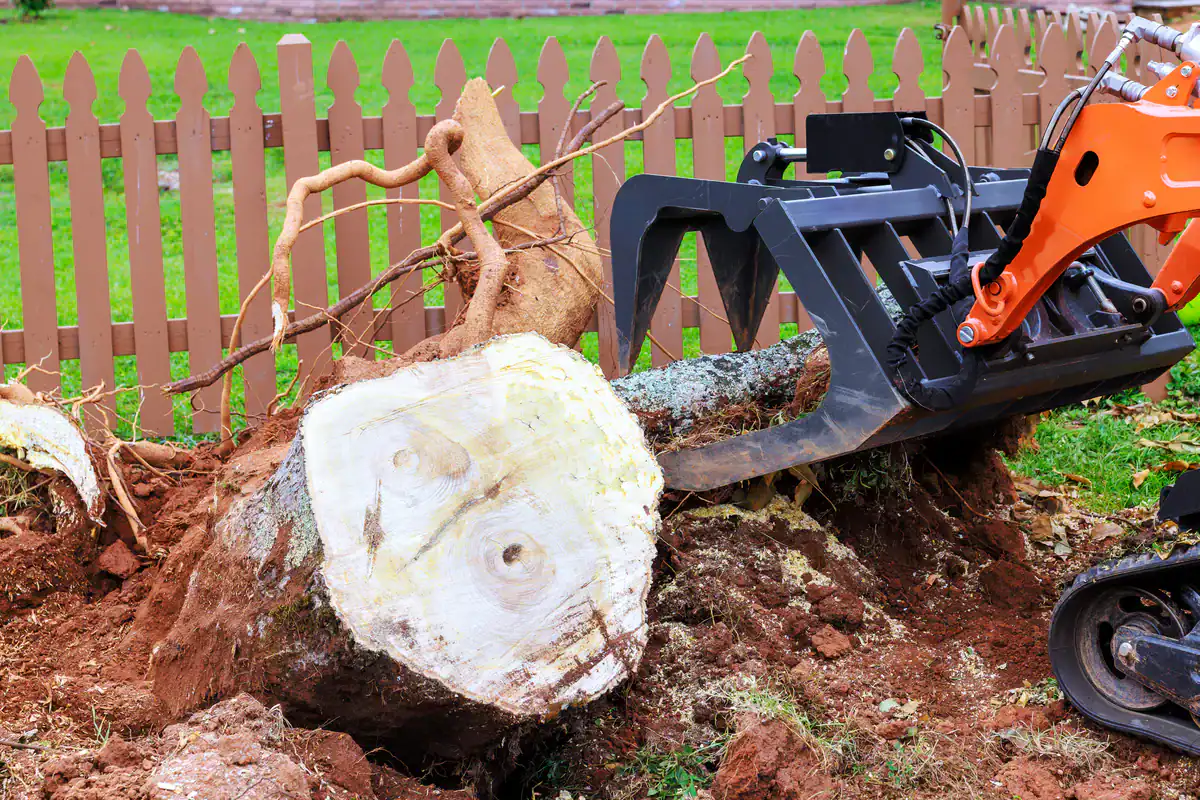
Stump grinding is not automatically bundled into every removal, but it is available and worth discussing before the job starts. After a large tree comes down, the stump left behind doesn’t decompose quickly — in Blue Springs’s clay soil, which holds moisture and compacts heavily, surface stumps can persist for years and become a tripping hazard, a mowing obstacle, and an eyesore in an otherwise clean yard.
Stump grinding takes the stump down below the surface, leaving the area ready for lawn restoration, replanting, or whatever you plan to do with the space. If you’re in a neighborhood with active HOA standards — like Adams Pointe Village or Vespers — or if you’re preparing a property for sale in Blue Springs’s active real estate market, getting the stump ground at the same time as the removal is usually the cleaner, more cost-effective approach than scheduling it separately later. Ask about it when you call for your estimate and we’ll factor it into the scope.
The first thing to verify — before price, before availability, before anything else — is insurance. Specifically, you want to confirm the company carries both general liability insurance and workers’ compensation coverage. In Missouri, there’s no state licensing requirement that prevents someone from calling themselves a tree service with nothing more than a truck and a chainsaw. That means the burden of verification falls on you. If a crew member gets injured on your property and the company doesn’t carry workers’ comp, you could be personally liable for the medical costs.
Beyond insurance, look for documented local experience — not just years in business generally, but familiarity with the specific conditions in Blue Springs: the clay soil, the storm exposure along the I-70 corridor, the mature tree canopy in the subdivisions that went up in the 1980s and 1990s. Check reviews on multiple platforms and look for specific details: did they clean up thoroughly, did they show up when they said they would, did they handle the job safely in a tight residential space? Those specifics matter more than star ratings alone. We carry full insurance, have over a decade of Kansas City, KS & MO metro experience, and have documented reviews from Jackson County homeowners describing exactly those outcomes.
Other Services we provide in Blue Springs