Westwood is one of the most densely packed cities in the entire Kansas City, KS & MO metro — roughly 4,200 people per square mile in just 0.40 square miles. When a tree goes down here, there’s almost nowhere for it to fall that doesn’t involve someone else’s roof, fence, car, or yard. A clean, controlled removal isn’t a luxury. It’s the only responsible option.
About 90% of the homes in Westwood were built before 1960. The trees that went in alongside those houses are now 60 to 75 years old, and many of them are showing it. Johnson County confirmed Emerald Ash Borer in 2013, and ash trees across Westwood that weren’t treated have had over a decade of exposure. Add in the clay-heavy soil that restricts root growth and accelerates decline, and you’ve got a neighborhood full of mature trees that look fine from the sidewalk but are quietly losing structural integrity.
When the work is done right, you get your yard back — no piles, no debris, no half-finished mess. You get peace of mind that the tree near your neighbor’s fence is gone before a spring storm makes the decision for you. And you get an honest answer about whether the tree actually needed to come down or just needed a professional trim.
We’re based in Kansas City, KS & MO, KS — right next door to Westwood. This isn’t a regional franchise dispatching a crew from across the metro. We know the area, the soil, and the kind of work that comes with removing large trees from dense, close-set residential neighborhoods like the ones along Belinder Avenue or near Westwood Park.
We’ve been doing this for over 10 years across the Kansas City, KS & MO metro, and we’ve deployed storm response operations across multiple states — Kansas, Missouri, and beyond. That kind of experience matters when the job involves a 70-year-old oak sitting 10 feet from your neighbor’s garage. We’re fully insured, which means liability coverage and workers’ compensation are both in place. If anything goes wrong on your property, you’re not the one holding the bill.
Every job ends with a full cleanup. No wood piles left in the yard, no chip debris scattered across the driveway. If you want to keep the wood or mulch, just say so in advance — we’ll make it work.
It starts with a free on-site estimate. We come out, look at the tree, and give you a straight answer — what it needs, what it’ll take to remove it safely, and what it’s going to cost. No vague ranges, no pressure. If a trim can solve the problem instead of a full removal, we’ll tell you that too. Westwood homeowners dealing with aging trees often aren’t sure what they’re actually looking at, and an honest assessment upfront saves everyone time.
Once you’re ready to move forward, scheduling is fast. Our customer reviews confirm same-day estimates and next-day work — which matters when you’re dealing with a storm-damaged limb or a tree that’s been leaning toward your neighbor’s property a little longer than it should have. In Westwood’s densely packed grid, waiting isn’t a neutral decision.
The removal itself is planned around the constraints of your specific lot — nearby structures, shared fence lines, overhead lines, neighboring yards. When we wrap up, we clean everything. The wood, the chips, the brush — all of it goes. You’re left with a clear yard and no follow-up calls needed.
Ready to get started?
Tree removal in Westwood isn’t a one-size situation. The combination of pre-1960 housing stock, clay-heavy soil, a confirmed Emerald Ash Borer presence in Johnson County since 2013, and one of the tightest residential densities in the metro creates a specific set of demands that not every crew is equipped to handle.
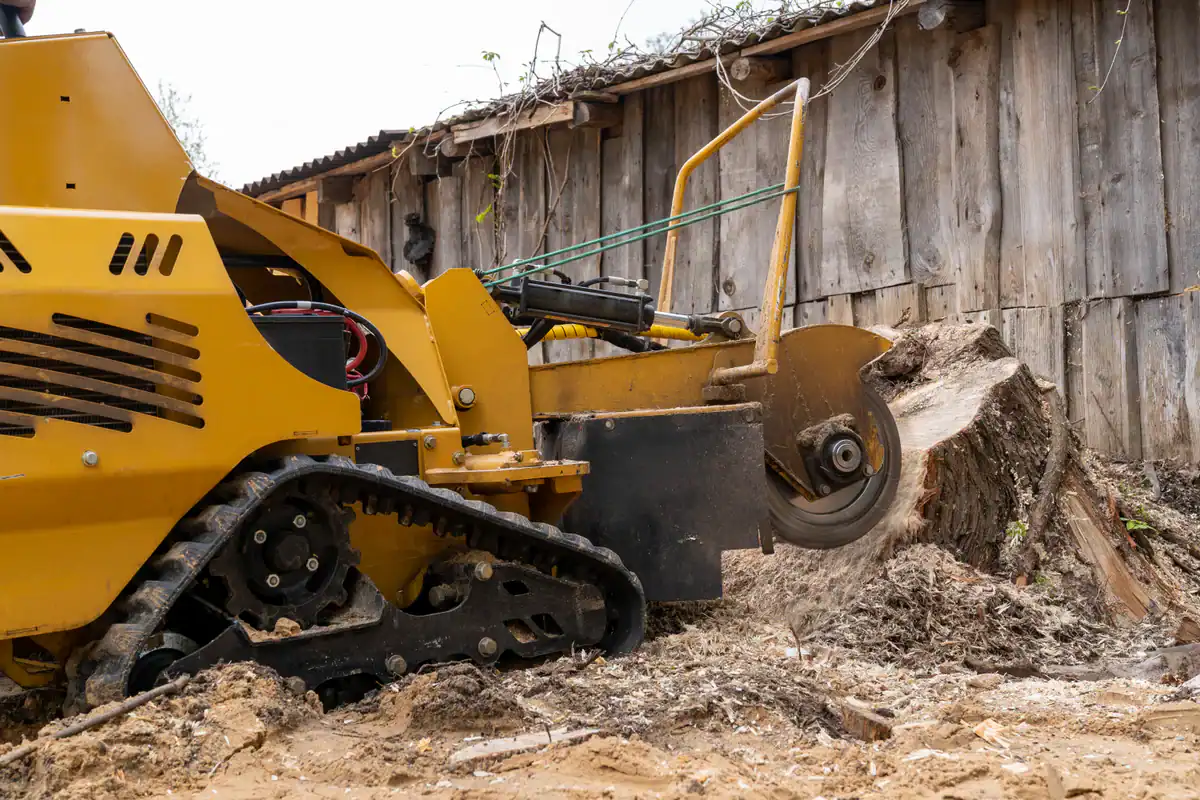
We cover the full range of what Westwood homeowners typically need: dead tree removal, diseased tree removal, hazardous tree removal, large tree removal, stump grinding, brush removal, and emergency storm response. If you’ve got an ash tree that’s been declining since EAB moved through, a large oak with a compromised root system in clay soil, or a storm-damaged limb hanging over your neighbor’s yard off Shawnee Mission Parkway, this is the kind of work we do regularly.
It’s also worth knowing that the adjacent city of Westwood Hills — which shares building inspection services with Westwood — has a municipal ordinance requiring homeowners to remove dead or diseased trees, with the city authorized to step in and bill you if you don’t. Whether or not an identical obligation applies to your specific property, the principle is the same: a dead or neglected tree is a liability, not just an eyesore. We handle the job from start to finish, including full cleanup, so you’re not managing multiple contractors or leftover debris.
Based on available information, Westwood does not appear to require a specific permit for removing a tree on your own private residential property. That said, if the work involves anything near a public right-of-way — a tree close to the sidewalk, a curb line, or a city easement — there may be a separate right-of-way permit involved, and any work near utility lines would require coordination with the relevant utility provider.
The neighboring city of Westwood Hills, which shares building inspection services with Westwood, has an explicit ordinance requiring homeowners to remove dead or diseased trees — with the city authorized to handle the removal and bill the homeowner if they don’t act. Whether a similar obligation applies in your specific situation, it’s worth knowing that local municipalities in this area take tree hazards seriously. If you’re unsure about your specific property, a quick call to Westwood City Hall at 4700 Rainbow Boulevard will get you a direct answer. We can also help you understand what the job involves before any work begins.
This is one of the most common questions Westwood homeowners ask, and the honest answer is that it depends on what’s actually going on with the tree — not just what it looks like from the yard. A tree that looks rough might only have surface-level damage, while a tree that looks fine from the outside could have significant internal decay, compromised root structure from years in clay-heavy soil, or active disease like Oak Wilt or Emerald Ash Borer damage.
A general rule of thumb: if less than 25% of a tree’s branches are damaged, it may survive with proper pruning. But dead branches — even on an otherwise healthy tree — can fall without warning, including on calm days with no wind. In Westwood, where lots are tight and neighboring structures are close, that’s not a risk worth taking on your own assessment. We’ll give you a straight answer on-site. If a trim is all you need, that’s what we’ll tell you. We’re not in the business of recommending full removal when it isn’t necessary.
It depends on the situation, and the details matter more than most homeowners realize. Generally, if a tree falls and damages a structure — your roof, your fence, your car — your homeowners insurance will typically cover some portion of the removal cost, often in the range of $500 to $1,000 for the removal itself, with the structural damage covered separately under your dwelling or personal property coverage.
Where it gets complicated is when the tree was already dead, diseased, or visibly compromised before it fell. If your insurer can show that you knew — or reasonably should have known — the tree was a hazard and didn’t act, they may deny the claim based on negligence. That’s a real clause in most homeowners policies, and it applies whether the tree falls on your own structure or on your neighbor’s property. In a city as densely packed as Westwood, where your trees are close to everyone else’s property, proactive removal is the financially responsible move — not just the cautious one.
For a smaller tree — say, under 30 feet — the removal itself typically takes two to four hours. A larger tree, which is far more common in Westwood given that most of the housing stock predates 1960 and the trees have had 60 to 75 years to grow, can take a full day depending on the size of the canopy, the proximity to structures, and how the removal needs to be staged to protect neighboring property.
In Westwood specifically, the tight lot conditions add time to the planning and rigging process. A tree that could be dropped in a single pass in an open suburban yard might need to come down in sections when it’s sitting 15 feet from a neighbor’s roofline or directly over a shared fence. That’s not a problem — it’s just the reality of working in a densely packed residential environment, and it’s exactly the kind of work we’re set up to handle. Cleanup is included in every job, so the total time on your property covers everything from the first cut to the final pass with the chipper.
Johnson County was confirmed as an Emerald Ash Borer-infested county in 2013, which means ash trees across Westwood have had well over a decade of exposure. If your ash tree wasn’t treated during that window, there’s a real chance it’s been affected. The signs to look for include thinning or dying branches starting at the top of the canopy and working downward, unusual sprouting from the base of the trunk or along the lower trunk (called epicormic sprouting, which is the tree’s stress response), and small D-shaped exit holes in the bark where adult beetles have emerged.
You might also notice the bark beginning to split or crack, or increased woodpecker activity — woodpeckers feed on EAB larvae and tend to work heavily infested trees. If the tree is showing significant dieback across more than half its canopy, removal is likely the only practical option at that point. A tree that’s 70% or more dead from EAB is also a structural hazard — the wood becomes brittle and unpredictable. In Westwood’s close-quarters environment, a dead ash near a structure or a neighbor’s property line needs to come down before a storm makes that decision for you.
This is the question that matters most in a city like Westwood. At 4,200 people per square mile in just 0.40 square miles, almost every tree removal job here involves proximity to something — a shared fence, a neighbor’s garage, a public sidewalk, an overhead line. There’s rarely an open drop zone.
The approach starts with a site assessment before any cutting begins. We look at the tree’s lean, the canopy spread, what’s in the fall zone, and what rigging or sectional removal is needed to bring it down safely. Large limbs get rigged and lowered rather than dropped when there’s a structure or a fence in the way. The work moves in stages when needed, with each section controlled before the next cut is made. One of our customers specifically noted that their large tree was removed in a dense neighborhood setting with no damage to their property or their neighbor’s — and that the cleanup extended to the neighbor’s yard as well. That’s the standard. Fully insured with liability coverage and workers’ compensation means that if something unexpected does happen, you and your neighbor are both protected.
Other Services we provide in Westwood