There’s a specific kind of relief that comes after a hazardous tree is gone. No more wondering if tonight’s storm is the one that finally brings it down on your fence, your car, or your roof. That’s not a small thing — especially in Raymore, where spring severe weather isn’t a maybe, it’s a when.
The April 2026 tornado and the major wind event that followed in May 2026 left a lot of Cass County homeowners dealing with downed trees and broken limbs they hadn’t planned on. If your yard is still showing the evidence of that, or if a tree on your property was already on borrowed time before those storms hit, the window to deal with it safely is now.
For homeowners in communities like Creekmoor, there’s another layer to consider. HOA property standards don’t pause while you figure out what to do with a dead oak near the lake. A diseased tree or a limb hanging over a neighbor’s fence can become a compliance issue fast. Getting it handled cleanly — with no debris pile left behind — means you’re not just solving a safety problem, you’re keeping your property in good standing with the association and your neighbors.
Raymore’s clay-heavy soil adds a complication that’s easy to miss. A tree can look stable above ground while its root system has been quietly weakening for years in compacted, waterlogged clay. That’s one of the reasons large trees in this area can come down on calm days with no warning. A professional assessment tells you what’s actually going on, not just what the tree looks like from the street.
We’ve been doing this work in the Kansas City, KS & MO metro for over a decade. That means Cass County clay, Missouri storm seasons, mature oaks near lakefront lots in Creekmoor, and the kind of tight residential neighborhoods where one wrong cut damages a fence or a neighbor’s garden. Our crew has seen all of it, and we handle it without shortcuts.
What actually sets us apart isn’t a tagline — it’s a pattern you can read in the reviews. Same-day or next-day estimates. Work completed and cleaned up the same day. Fair pricing with no games. And a crew that treats your yard like we live next door, because in the Kansas City, KS & MO area, we just might.
We’re fully insured — liability and workers’ comp — which matters more than most homeowners realize until something goes wrong. We’ve also deployed to multi-state storm recovery operations across Missouri, Kansas, North Carolina, South Carolina, and Florida. That’s not a local outfit figuring things out as we go. That’s a team that has worked large-scale storm damage and brought that experience back to every job we take in Raymore.
It starts with a free estimate. We come out to your property, look at the tree in question, and give you a straight answer about what needs to happen and what it’s going to cost. If a strategic trim can solve the problem, we’ll tell you that too. There’s no incentive to upsell a full removal when a crown reduction does the job — and an honest assessment upfront is what builds the kind of trust that brings customers back.
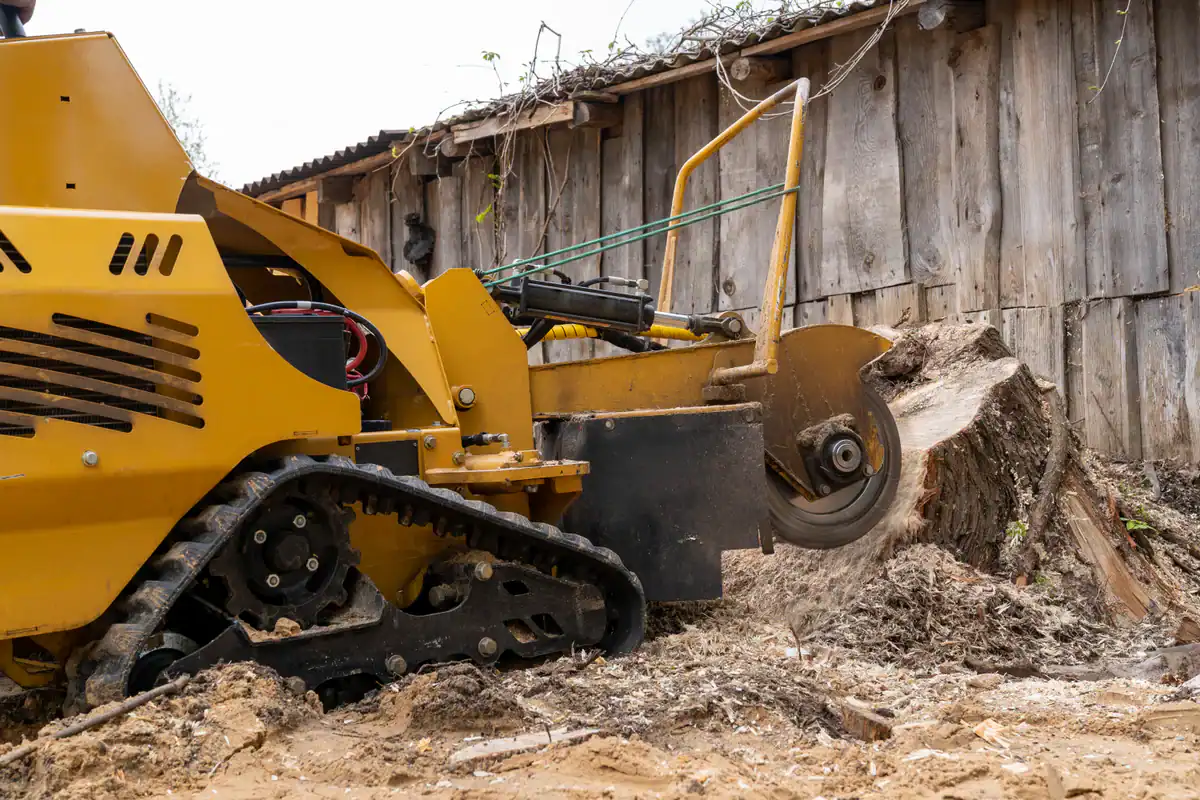
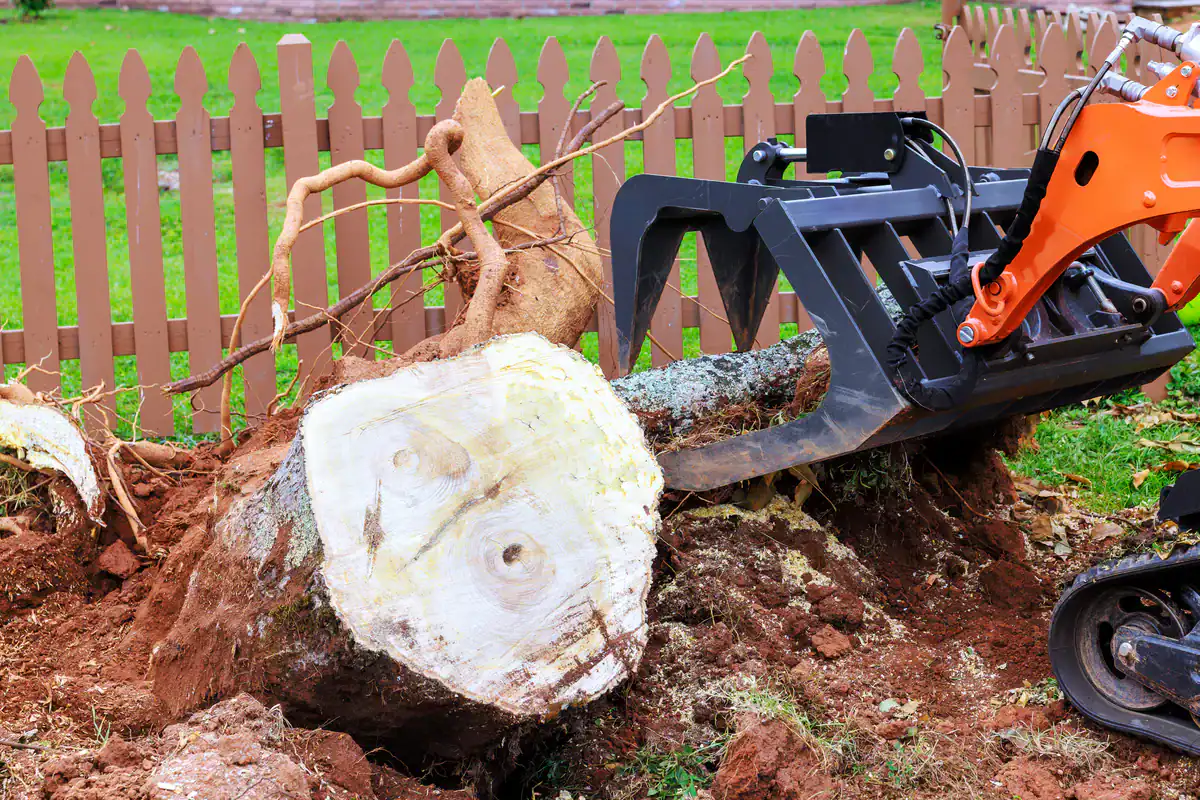
Once you’re ready to move forward, our crew gets to work. For most residential tree removals in Raymore, the job is completed the same day — including cleanup. Every job ends with a clean property. No wood piles, no chip piles, no debris left for you to deal with later. If you want to keep the wood or mulch for personal use, just say so in advance and we’ll set it aside. Stump grinding is also available if you want the area restored to something close to its original condition, which matters in HOA communities like Creekmoor where a visible stump can become its own problem.
One thing worth knowing for Raymore specifically: Missouri has no statewide permit requirement for removing trees on private residential property, so there’s no waiting on paperwork for a standard job. If your tree is in or near the public right-of-way, or if your HOA has its own approval process, that’s worth a quick check before our crew arrives — but for most homeowners dealing with a dead, diseased, or storm-damaged tree on their own lot, the process moves fast. After the April and May 2026 storm events, fast is exactly what a lot of Raymore residents needed.
Ready to get started?
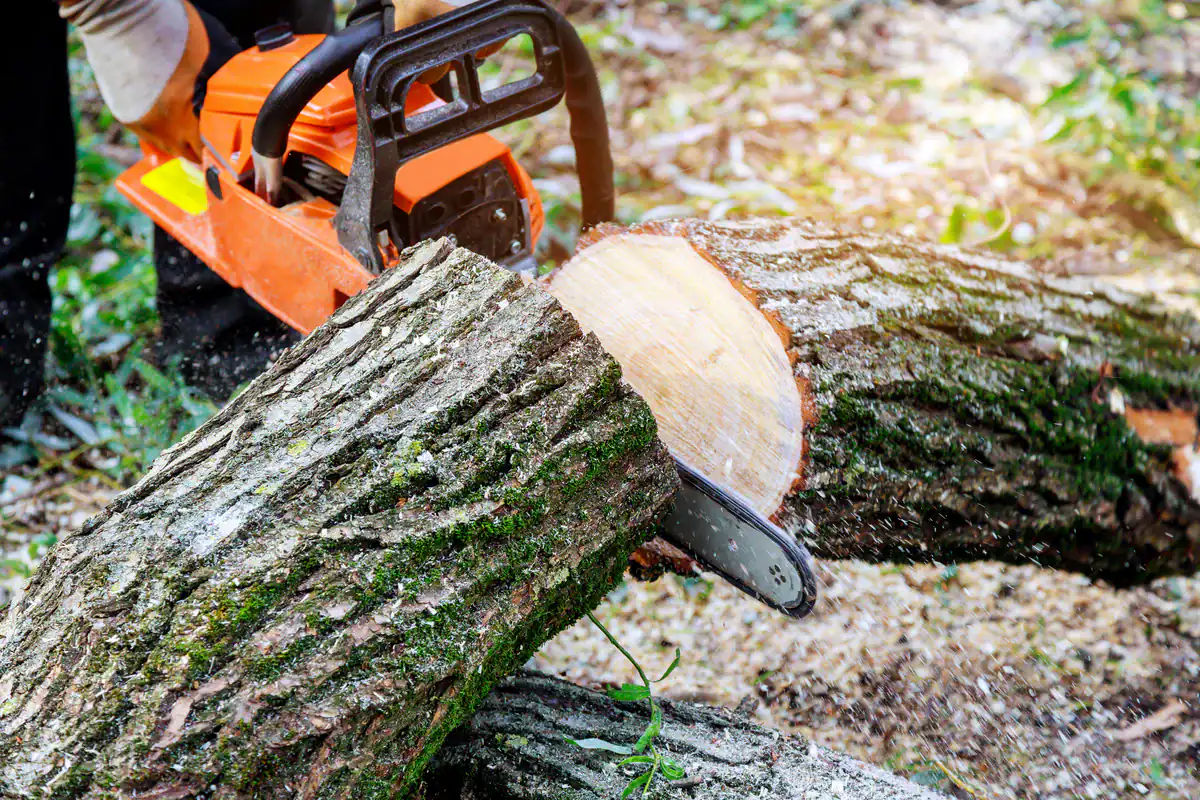
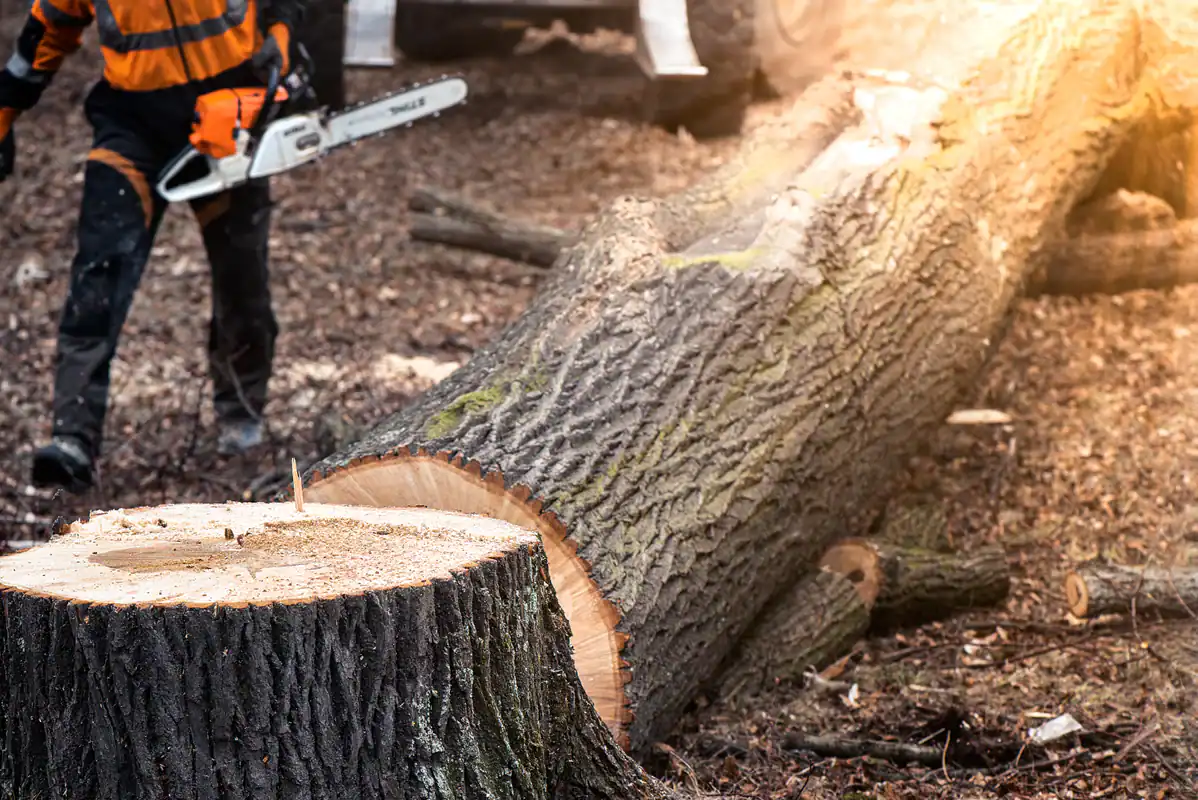
Tree removal in Raymore covers more ground than most people expect when they first call. Whether it’s a dead tree that’s been leaning toward the house since last winter, a diseased tree showing signs of Oak Wilt or Emerald Ash Borer damage, a large tree that came down in a storm, or a hazardous limb hanging over a roof in a tight neighborhood — the work is the same: get it down safely, get it cleaned up completely, and leave the property in better shape than we found it.
We offer tree removal, tree trimming and pruning, stump removal and stump grinding, brush removal, and emergency storm response. Full cleanup is included with every removal job. No named packages, no tiered pricing structures — just a straight assessment of what the job requires and a fair quote before anything starts.
For Raymore homeowners in Creekmoor and other HOA-governed communities, the cleanup standard matters as much as the removal itself. Lakefront lots, golf course-adjacent properties, and homes in dense subdivisions all require extra care around neighboring structures, landscaping, and shared spaces. Our crew works with that in mind. And because we’re fully insured, if anything unexpected happens on your property during the job, you’re covered — not left holding the bill for someone else’s mistake.
Not every dead tree is an immediate emergency, but most dead trees in Raymore should be taken seriously sooner rather than later. Dead trees don’t only fall during storms. Once a tree loses structural integrity, it can come down on a calm day with no warning — and Cass County’s clay soil can accelerate that process by weakening root systems from the ground up without any visible signs above ground.
There’s also a financial reason to act. If a dead tree on your property falls and damages your home or a neighbor’s property, your homeowners insurance may deny the claim if they determine you knew the tree was dead or diseased and didn’t address it. Insurance companies do apply negligence clauses in exactly these situations. After the two significant storm events that hit Raymore in spring 2026, a lot of homeowners are now looking at trees they’d been putting off. Getting an honest assessment now costs nothing and tells you exactly where you stand.
Tree removal costs vary based on the size of the tree, its location on your property, and how much complexity is involved — things like proximity to your house, a fence, power lines, or in Creekmoor, a lakefront retaining wall or golf course boundary. Nationally, most tree removals fall somewhere between $750 and $1,200 for a standard job, though larger or more complicated trees can run higher.
The best way to know what your specific job will cost in Raymore is to get a free on-site estimate from us. We’ll come out, look at the tree, and give you a real number — not a range so wide it’s useless. There are no hidden fees and no bait-and-switch. The price you’re quoted is the price you pay. If the job turns out to be simpler than expected, that shows up in the quote too.
For most standard residential tree removals on private property in Raymore, you do not need a permit. Missouri has no statewide licensing requirement for tree removal on private lots, and Raymore’s municipal code regulates tree removal primarily in the context of new development and trees in the public right-of-way — not a dead or hazardous tree in your backyard.
That said, there are two situations where you’ll want to check before anything gets cut. First, if the tree is in or near the public right-of-way or is a designated street tree, Raymore’s Development Services Department has oversight there. Second, if you live in a community like Creekmoor with an active HOA, the association may have its own approval process for removing trees that are visible from common areas or that affect shared landscaping. Neither of these is typically a long delay, but it’s worth a quick check so the job can move forward without interruption.
The clearest signs are structural — a significant lean that wasn’t there before, large dead branches throughout the canopy, bark that’s cracking or falling away, or a hollow trunk. Fungal growth at the base of the tree is another red flag, as it usually signals decay that’s already well advanced on the inside.
In Raymore specifically, there are a few local factors that accelerate the timeline. The area’s heavy clay soil can cause root systems to weaken gradually without obvious surface signs, making trees more vulnerable to wind than they appear. Kansas City, KS & MO-area trees are also susceptible to Emerald Ash Borer, Oak Wilt, and Bagworm damage — all of which can kill a tree relatively quickly once they take hold. If you have an ash tree that’s been looking thin for a season or two, or an oak with unusual leaf loss, those are worth a closer look before the next storm season arrives.
Yes — full cleanup is included on every job. That means no wood piles, no chip piles, no debris scattered across your lawn when we leave. The property gets left clean. If you want to keep the wood for firewood or the chips for mulch, just let us know before the job starts and we’ll set it aside for you. If you don’t want it, it goes with our crew.
This matters more than it sounds, especially in Raymore’s HOA-governed communities. In a neighborhood like Creekmoor, leaving a debris pile on the lawn isn’t just an inconvenience — it can draw attention from the association or create friction with neighbors. The cleanup standard that we hold to on every job is part of what makes the work right for communities where property appearance is taken seriously. Stump grinding is also available if you want the area fully restored after the tree is gone.
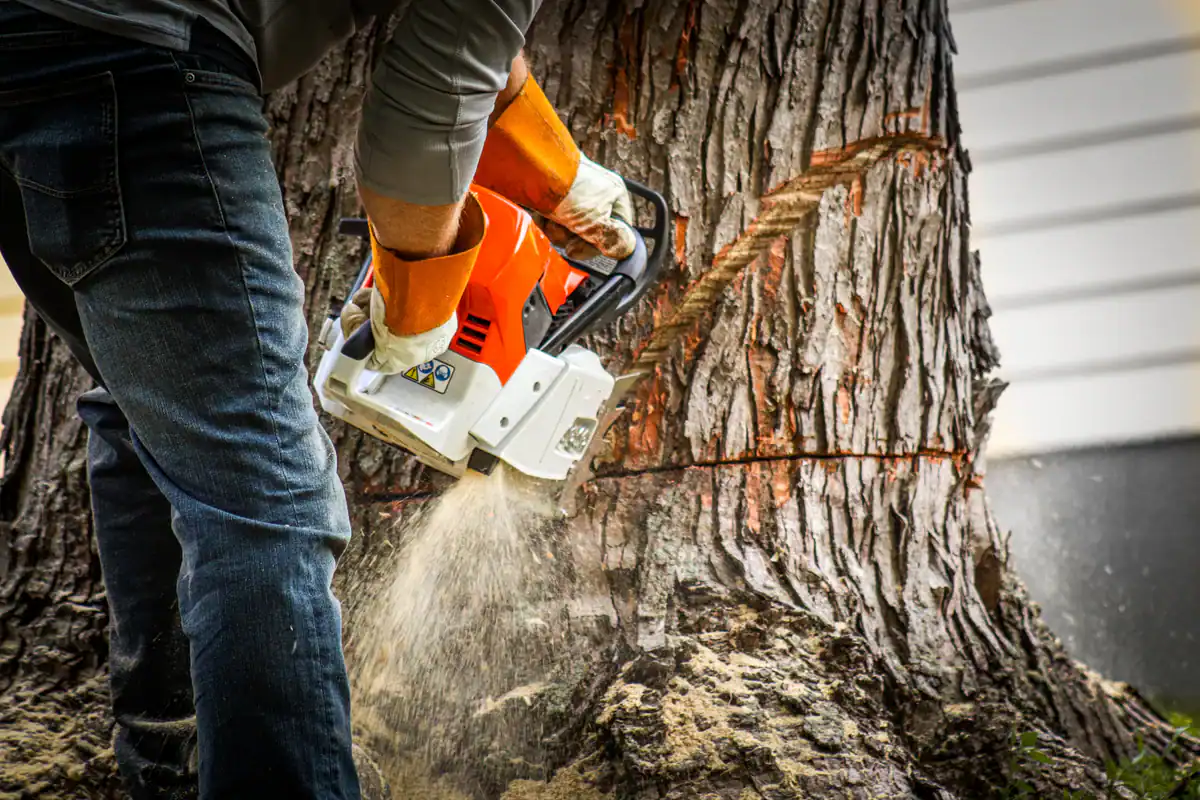
It can be — but it requires the right crew and the right approach. Large tree removal near structures is one of the more technically demanding jobs in this field. The tree has to come down in sections, in a controlled sequence, with rigging that keeps each piece from swinging into the house, fence, or anything else nearby. It’s not a job for someone with a chainsaw and a pickup truck, and it’s definitely not something where low price should be the deciding factor.
We have a documented track record of safely removing large trees in tight residential settings — including in dense neighborhoods where the margin for error is small and neighboring properties are close. Our crew is fully insured for exactly these situations, which means if something unexpected does happen, you’re not personally liable for the damage. In Raymore’s established neighborhoods, where homes are sitting at a median value around $339,000, that insurance coverage isn’t a formality — it’s the thing that protects your investment if a job gets complicated.
Other Services we provide in Raymore